Inpage Navigation Section: Overview
2027
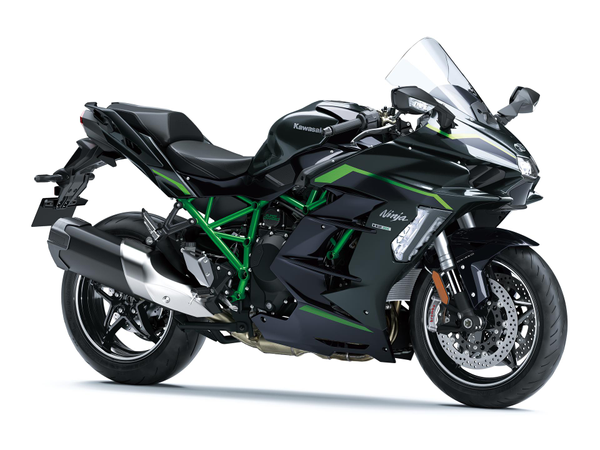
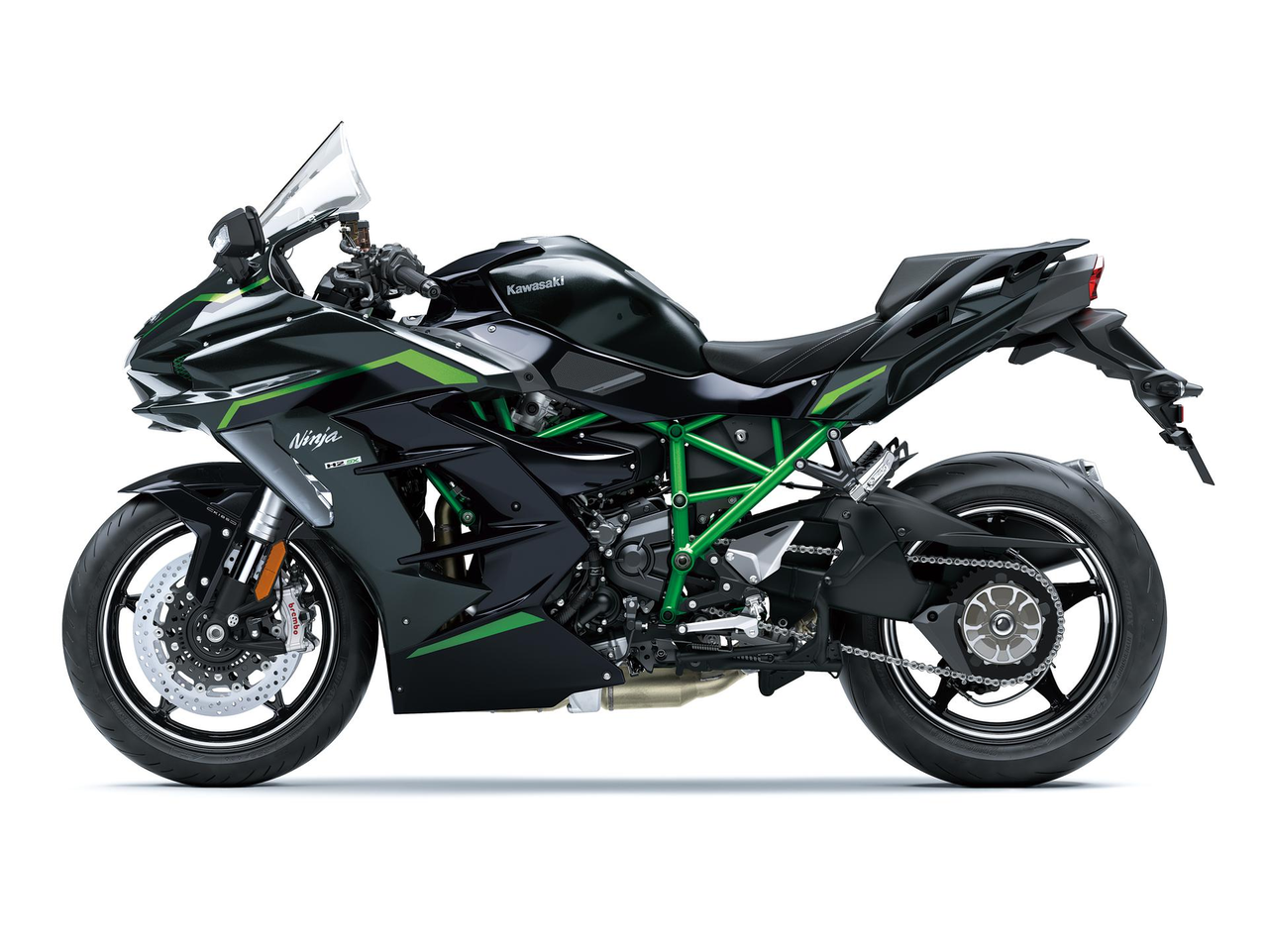
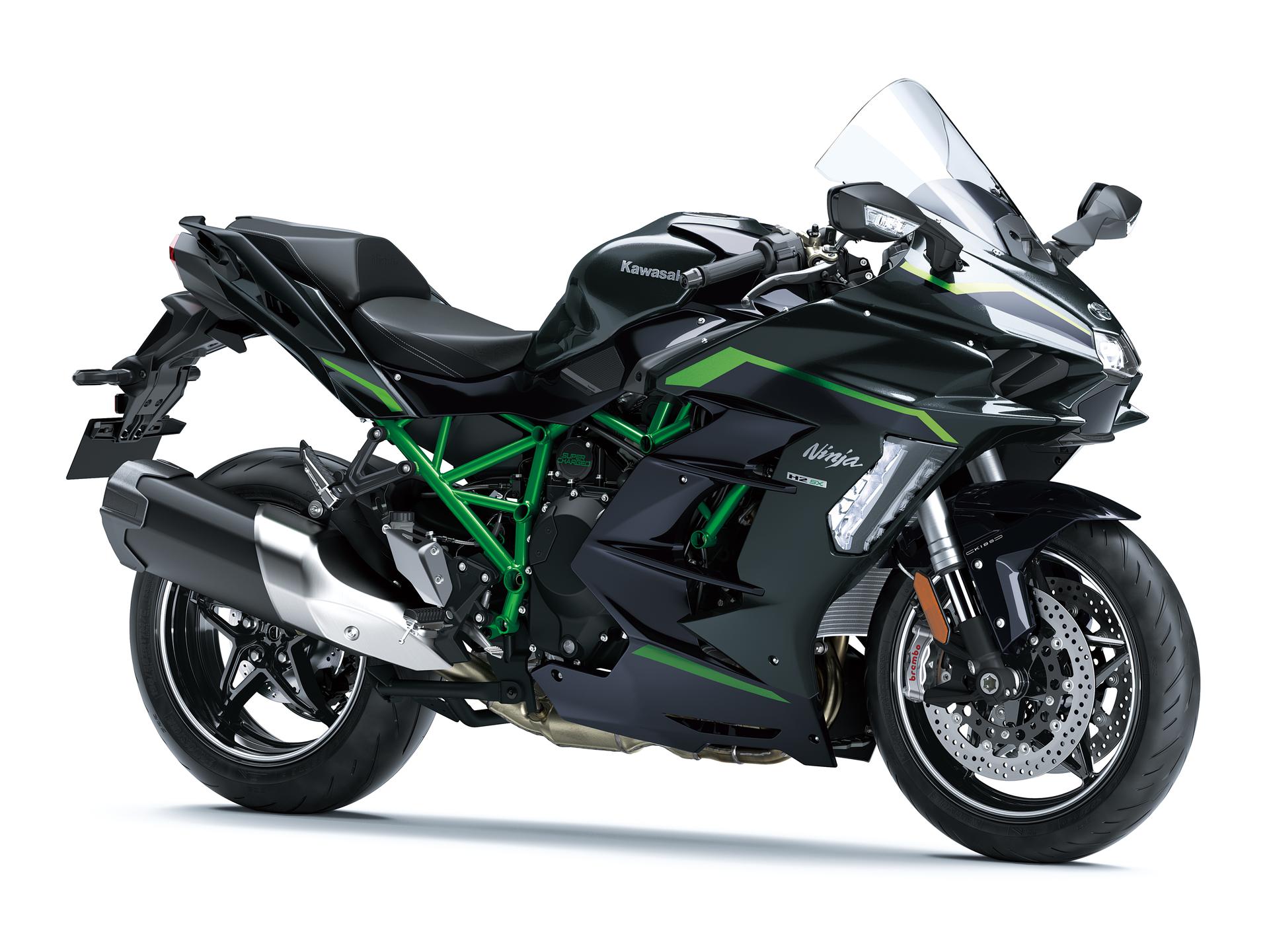
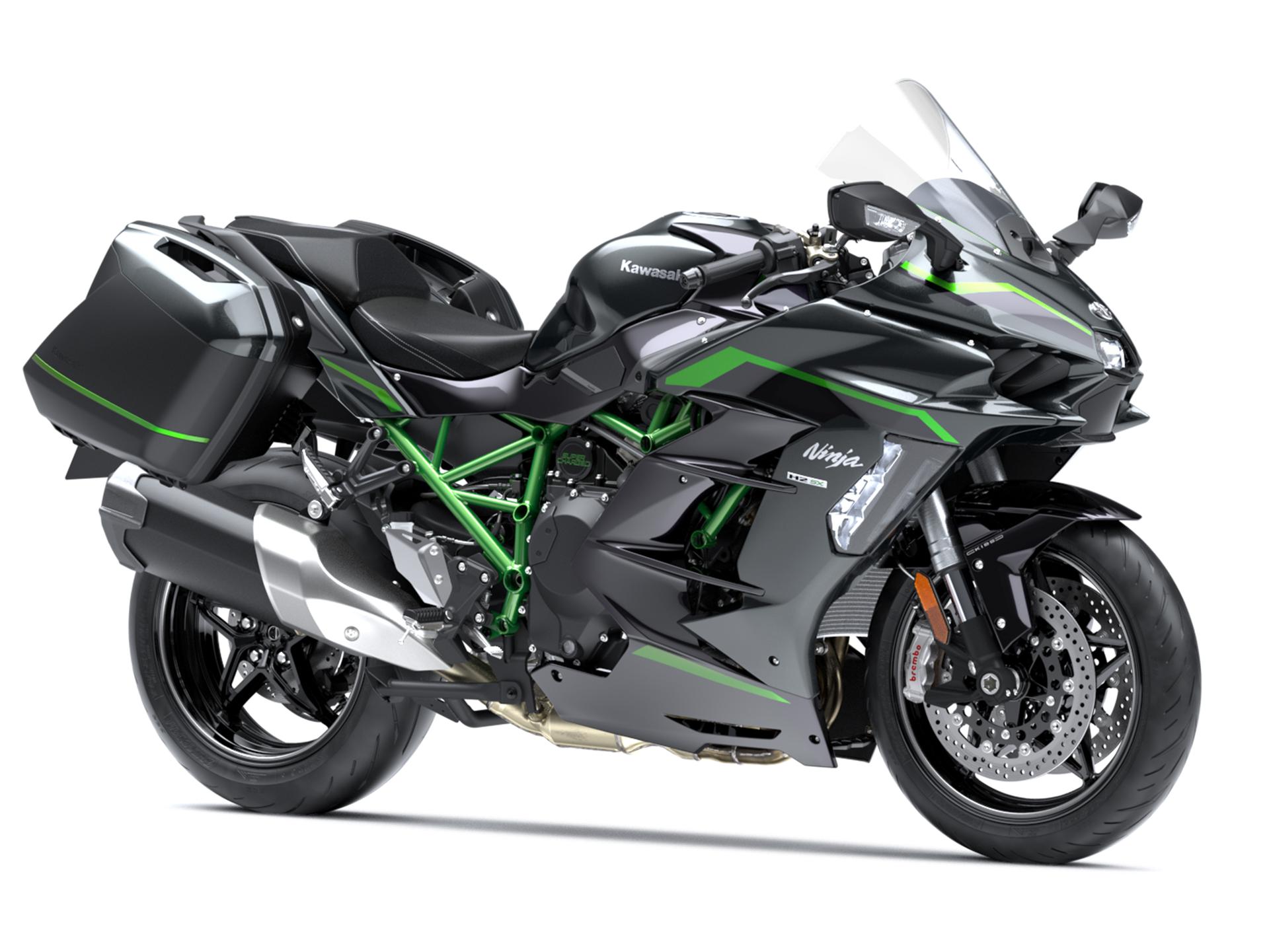
Ninja H2 SX SE
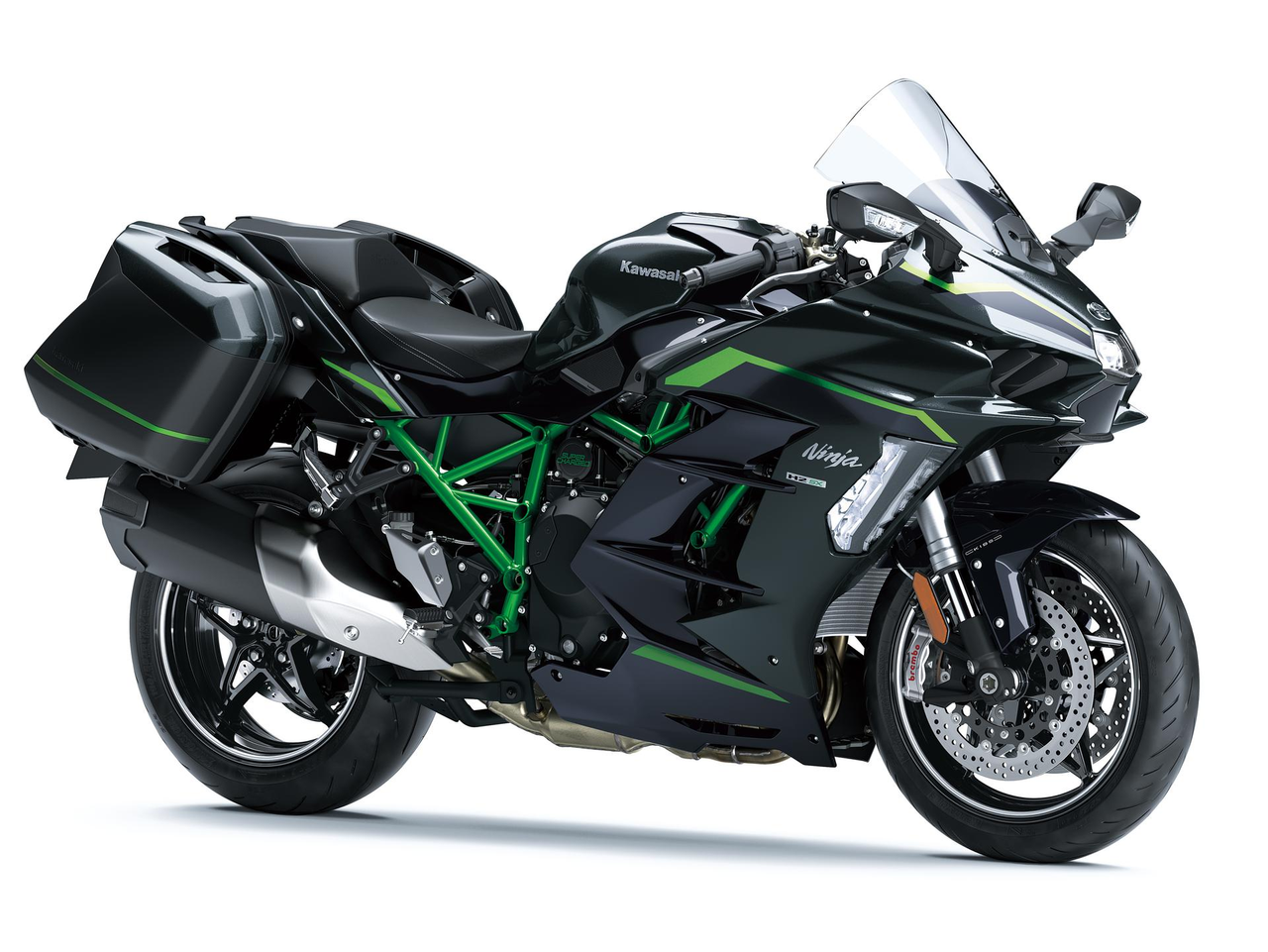
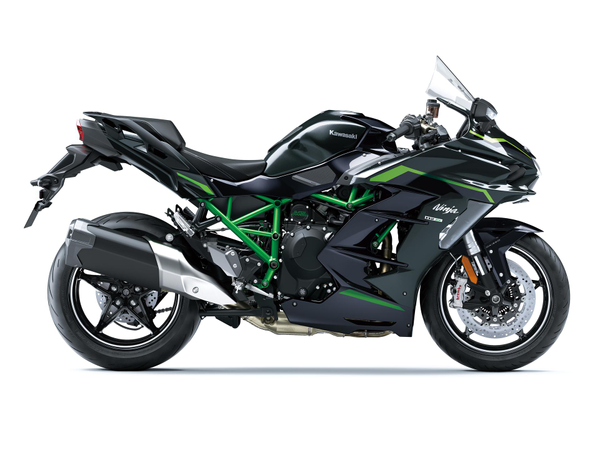
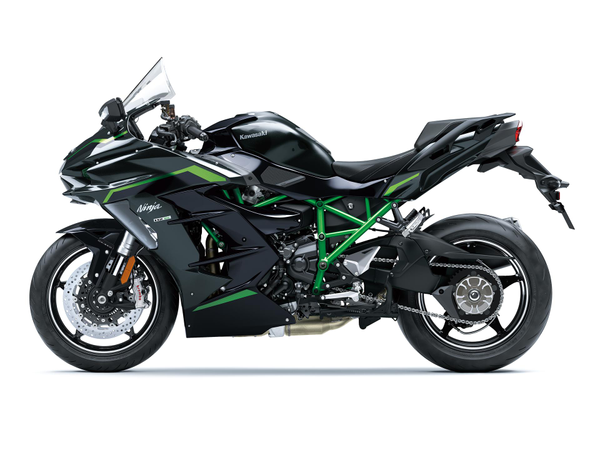
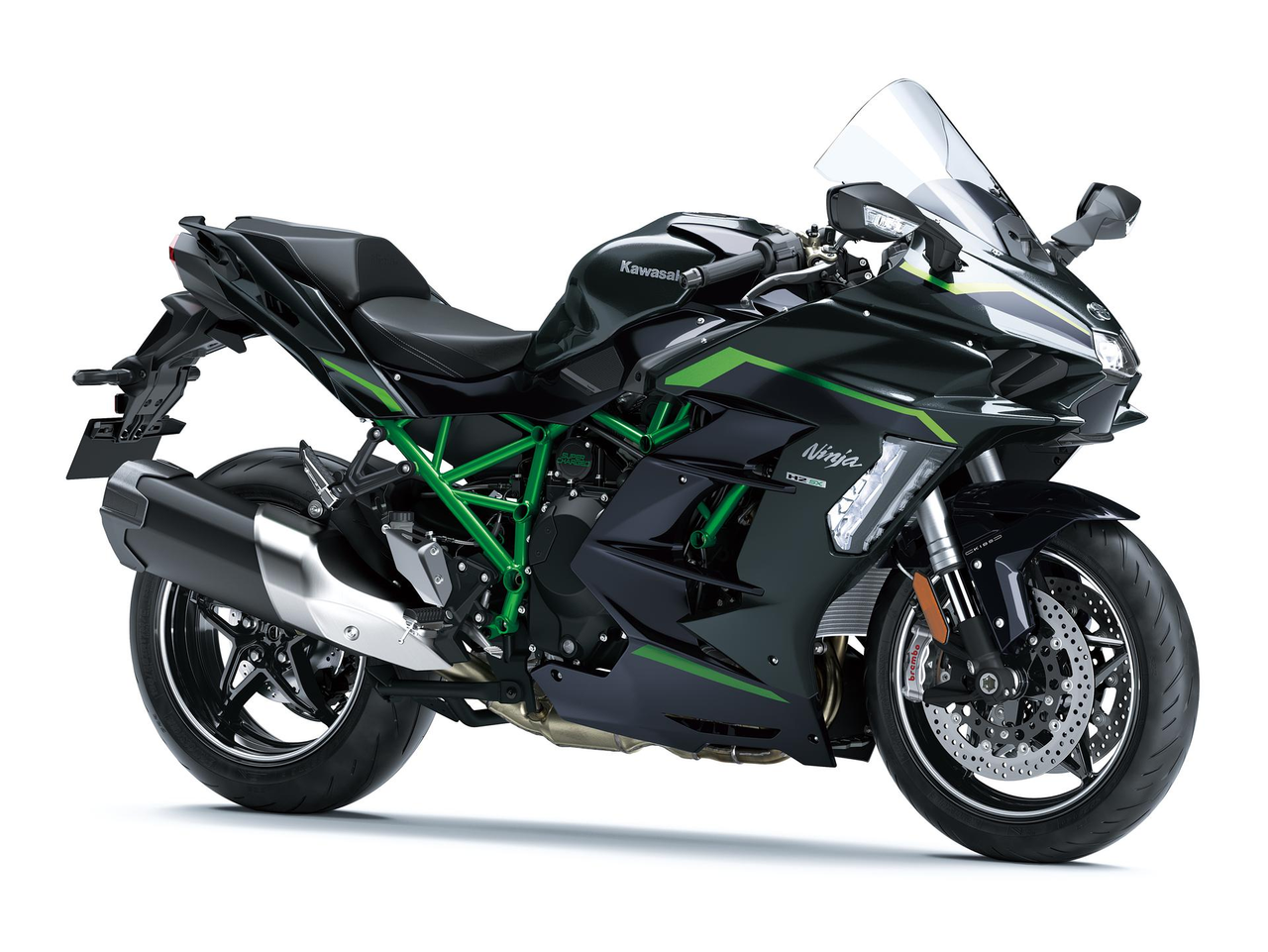
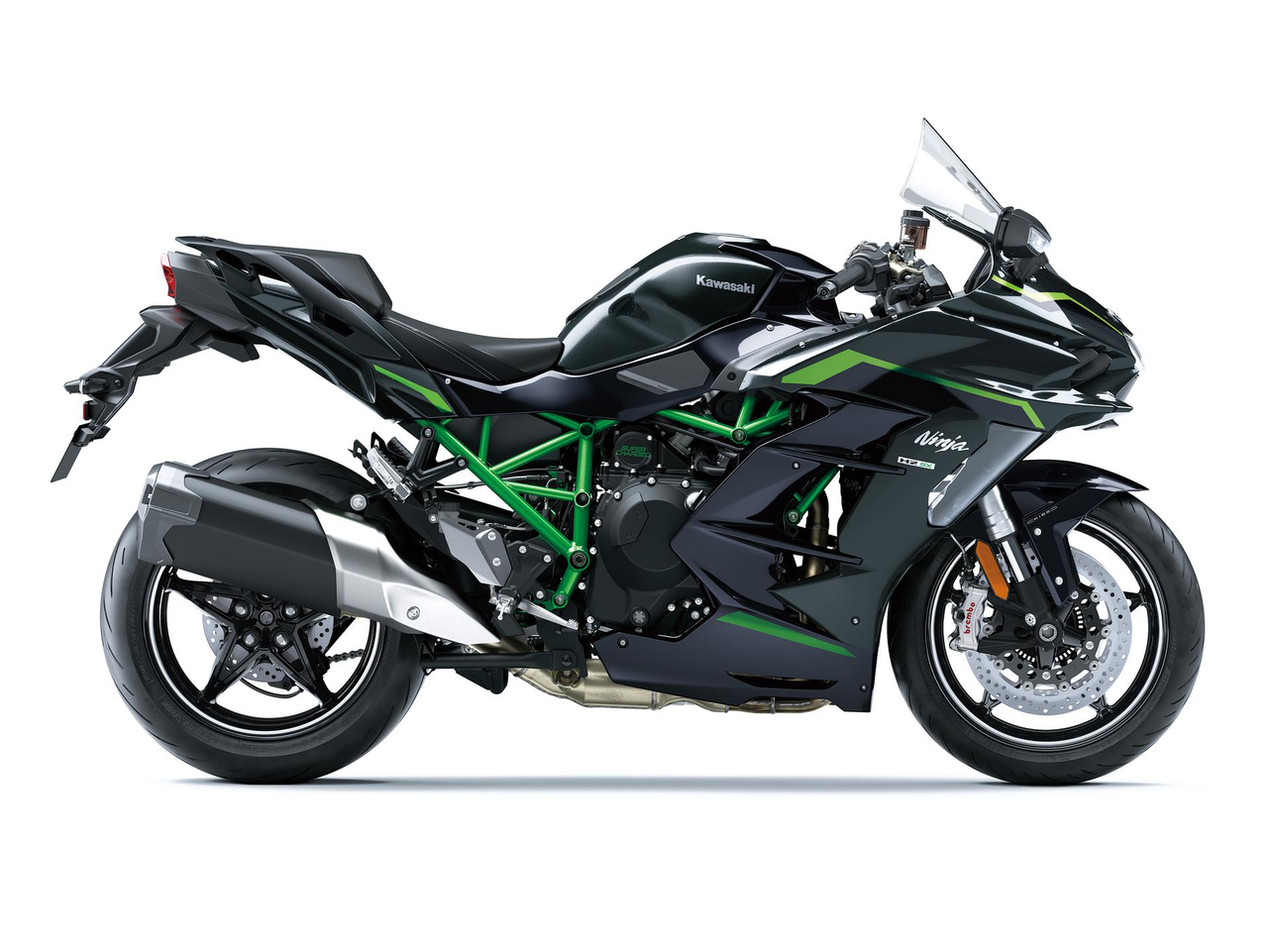
The Kawasaki Ninja H2 SX is Kawasaki's most advanced Sports Tourer ever; the ultimate integration of the highest standards of technology, performance and riding comfort.
New dedicated features like the ARAS system provide real world benefits including adaptive cruise control and blind spot detection. Integrated into the new 6.5” colour TFT instrumentation is Kawasaki's SPIN Infotainment system.
Experience the exhilaration of the unique balanced supercharged engine for both long distance touring and daily riding.
The best technology is that which becomes a natural extension of ourselves and sets us free.
Ninja H2 SX. ENGINEERED TO BE FREE.
Colour
Editions of Ninja H2 SX SE
Ninja H2 SX SE
Show all
Show less
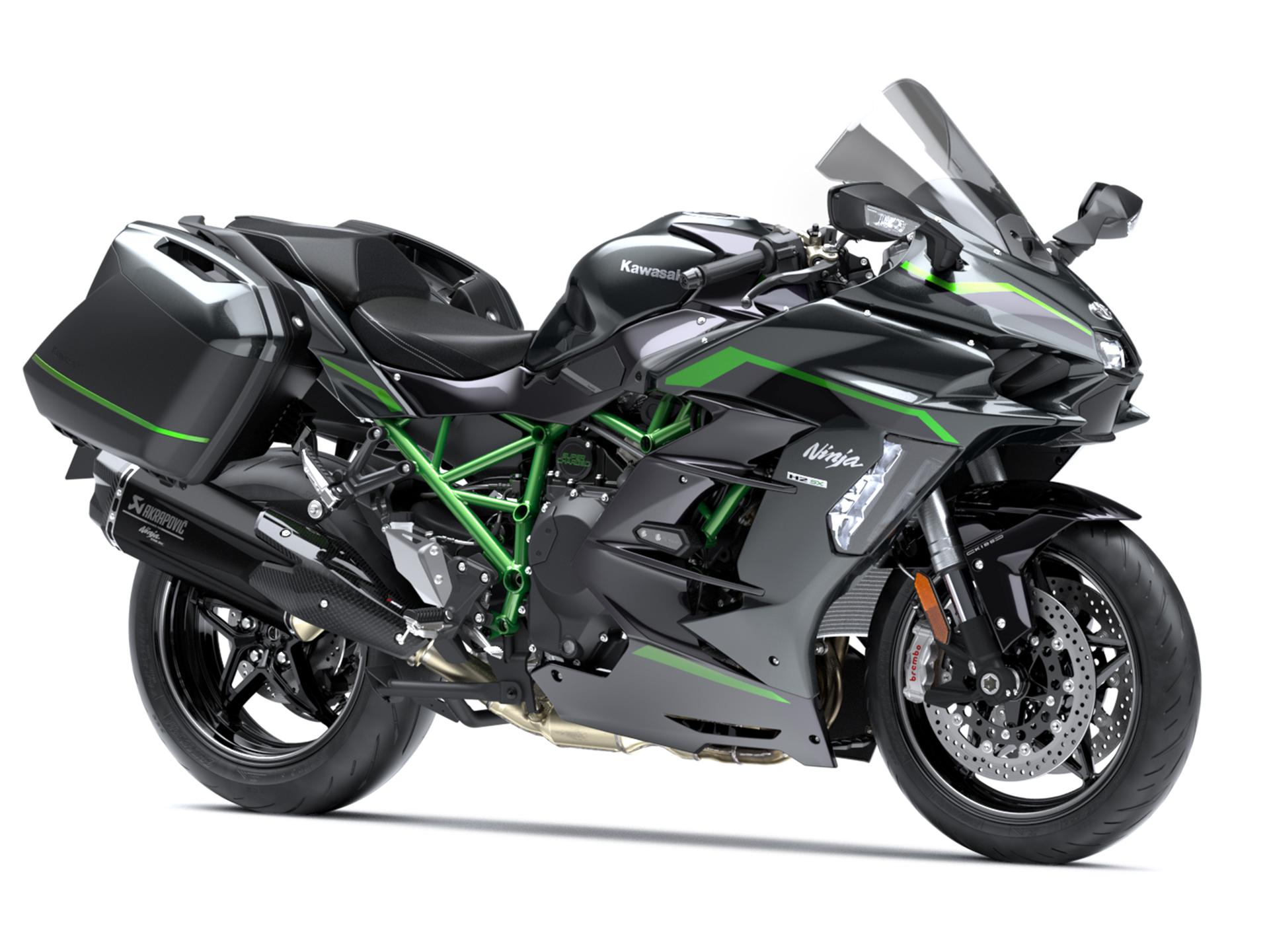
Ninja H2 SX SE Performance Tourer
Edition Accessories
Show all
Show less
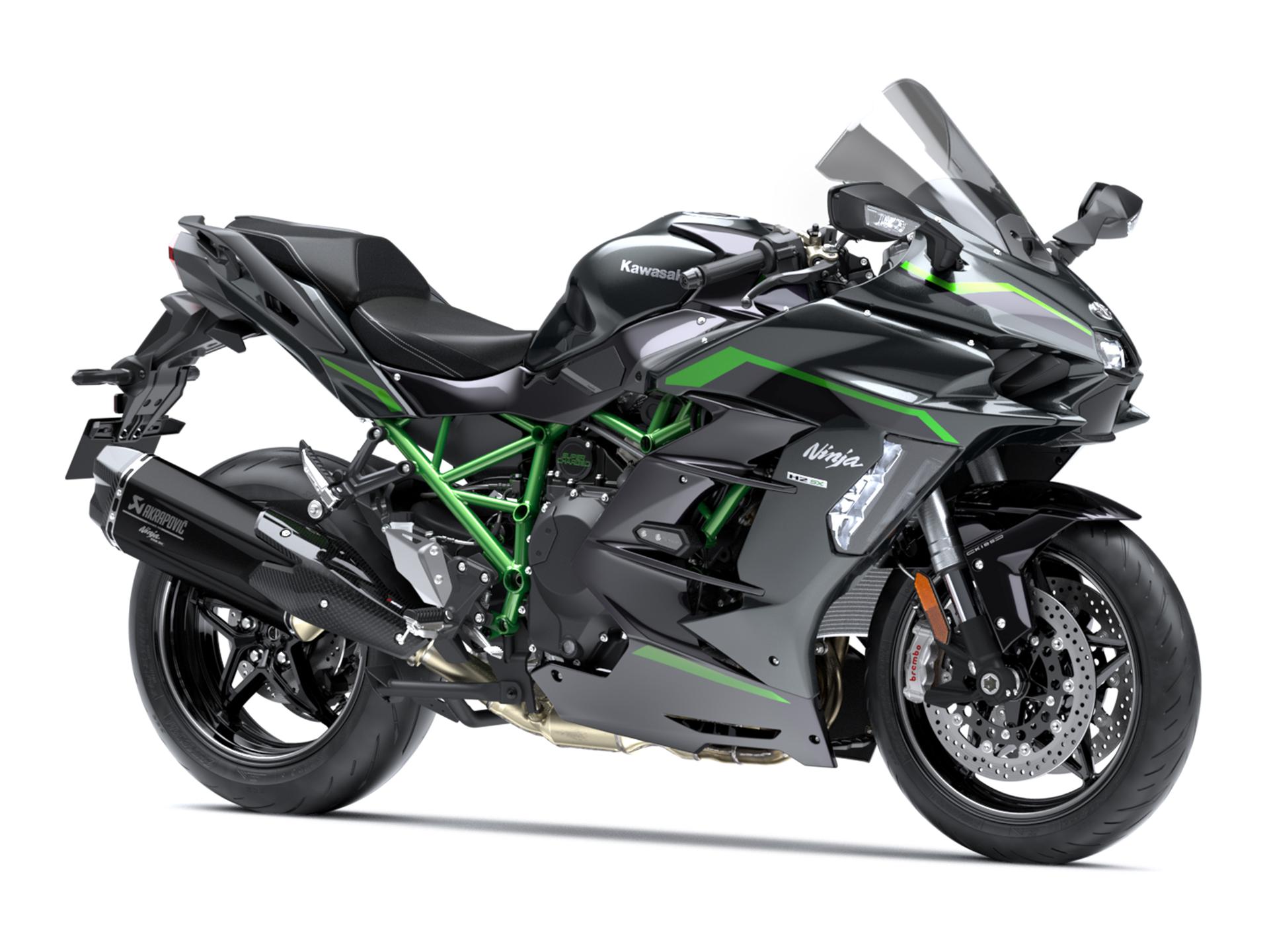
Ninja H2 SX SE Performance
Edition Accessories
Show all
Show less
- Metallic Carbon Gray / Metallic Diablo Black
Inpage Navigation Section: Gallery
Inpage Navigation Section: Features & Specs
- Features
- Technologies
- Specifications
KECS with Skyhook
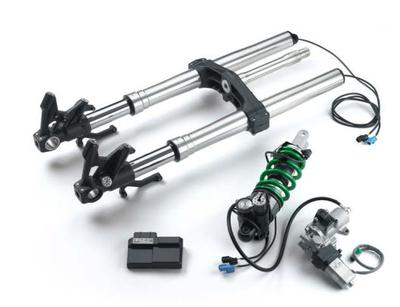
KECS, Kawasaki’s semi-active electronic suspension system, adapts to road and riding conditions in real time, providing the ideal amount of damping called for. Updated software incorporates Skyhook technology to deliver an even more composed ride, contributing to increased comfort and enjoyment.
KECS with Skyhook
KECS, Kawasaki’s semi-active electronic suspension system, adapts to road and riding conditions in real time, providing the ideal amount of damping called for. Updated software incorporates Skyhook technology to deliver an even more composed ride, contributing to increased comfort and enjoyment.
Supercharged Sport Touring
Originally conceived to be the fastest sport tourer on the Autobahn, the Ninja H2 SX offers a unique riding experience. With supercharged acceleration and the equipment to cover long distances in comfort, Kawasaki’s supercharged sport tourer will have riders smiling in their helmets as they eat up the miles.
Supercharged Sport Touring
Originally conceived to be the fastest sport tourer on the Autobahn, the Ninja H2 SX offers a unique riding experience. With supercharged acceleration and the equipment to cover long distances in comfort, Kawasaki’s supercharged sport tourer will have riders smiling in their helmets as they eat up the miles.
Flagship Convenience Features
Befitting a flagship model, the Ninja H2 SX features large, full colour instrumentation in addition to a host of high-grade convenience features including KIPASS and TPMS.
Flagship Convenience Features
Befitting a flagship model, the Ninja H2 SX features large, full colour instrumentation in addition to a host of high-grade convenience features including KIPASS and TPMS.
Leading-Edge Technology
The Ninja H2 SX is Kawasaki’s first model to integrate an FI-ECU with torque-demand capabilities; new IMU that measures in six DOF; and boost-circuit-equipped ABS with high computational power, enabling coordinated chassis control. Equipped with Bosch’s Advanced Rider Assistance Systems and (on the SE model) Showa’s Skyhook Technology, the Ninja H2 SX is Kawasaki’s most advanced model to date.
Leading-Edge Technology
The Ninja H2 SX is Kawasaki’s first model to integrate an FI-ECU with torque-demand capabilities; new IMU that measures in six DOF; and boost-circuit-equipped ABS with high computational power, enabling coordinated chassis control. Equipped with Bosch’s Advanced Rider Assistance Systems and (on the SE model) Showa’s Skyhook Technology, the Ninja H2 SX is Kawasaki’s most advanced model to date.
Balanced Supercharged Engine
Designed to offer both power and fuel efficiency, the Balanced Supercharged Engine delivers a maximum power of 200 PS. Tuning focused on the low-mid range prioritises everyday usability in street-riding situations over outright performance, and helps to achieve fuel efficiency exceeding that of the Ninja 1000SX and Versys 1000.
Balanced Supercharged Engine
Designed to offer both power and fuel efficiency, the Balanced Supercharged Engine delivers a maximum power of 200 PS. Tuning focused on the low-mid range prioritises everyday usability in street-riding situations over outright performance, and helps to achieve fuel efficiency exceeding that of the Ninja 1000SX and Versys 1000.
Kawasaki Rider Support Technology
Kawasaki’s highly sophisticated electronic management systems offer rider support to allow them to more fully experience how the Ninja H2 SX is fun and rewarding to control.
Kawasaki Rider Support Technology
Kawasaki’s highly sophisticated electronic management systems offer rider support to allow them to more fully experience how the Ninja H2 SX is fun and rewarding to control.
Auto High Beam (AHB)
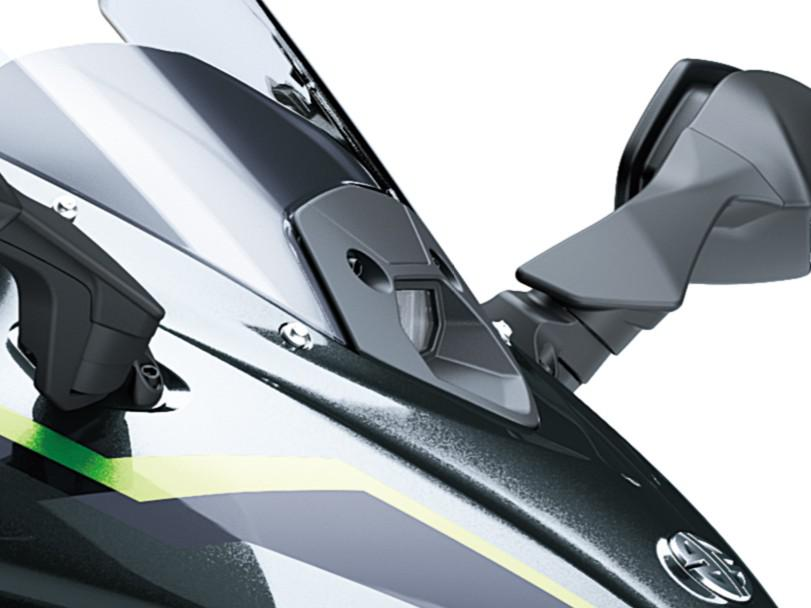
Using a camera sensor to assess the brightness of the lights of vehicles ahead, of streetlights, etc. AHB automatically turns the bike’s high beams on or off as necessary. For the system to function, the dimmer/passing switch must be set to high beam, the bike must be travelling above 20 km/h, and it must be dark. When the system has been engaged, the icon displayed on the instrument screen will show green.
Auto High Beam (AHB)
Using a camera sensor to assess the brightness of the lights of vehicles ahead, of streetlights, etc. AHB automatically turns the bike’s high beams on or off as necessary. For the system to function, the dimmer/passing switch must be set to high beam, the bike must be travelling above 20 km/h, and it must be dark. When the system has been engaged, the icon displayed on the instrument screen will show green.
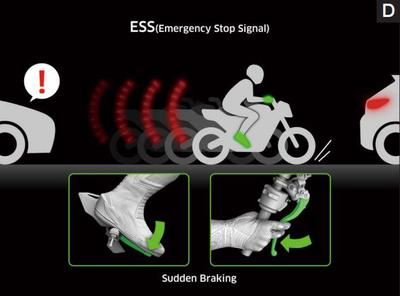
Emergency Stop Signal (ESS)
During hard braking, ESS causes the brake light to flash, calling attention to the bike’s quick deceleration.
Emergency Stop Signal (ESS)
During hard braking, ESS causes the brake light to flash, calling attention to the bike’s quick deceleration.
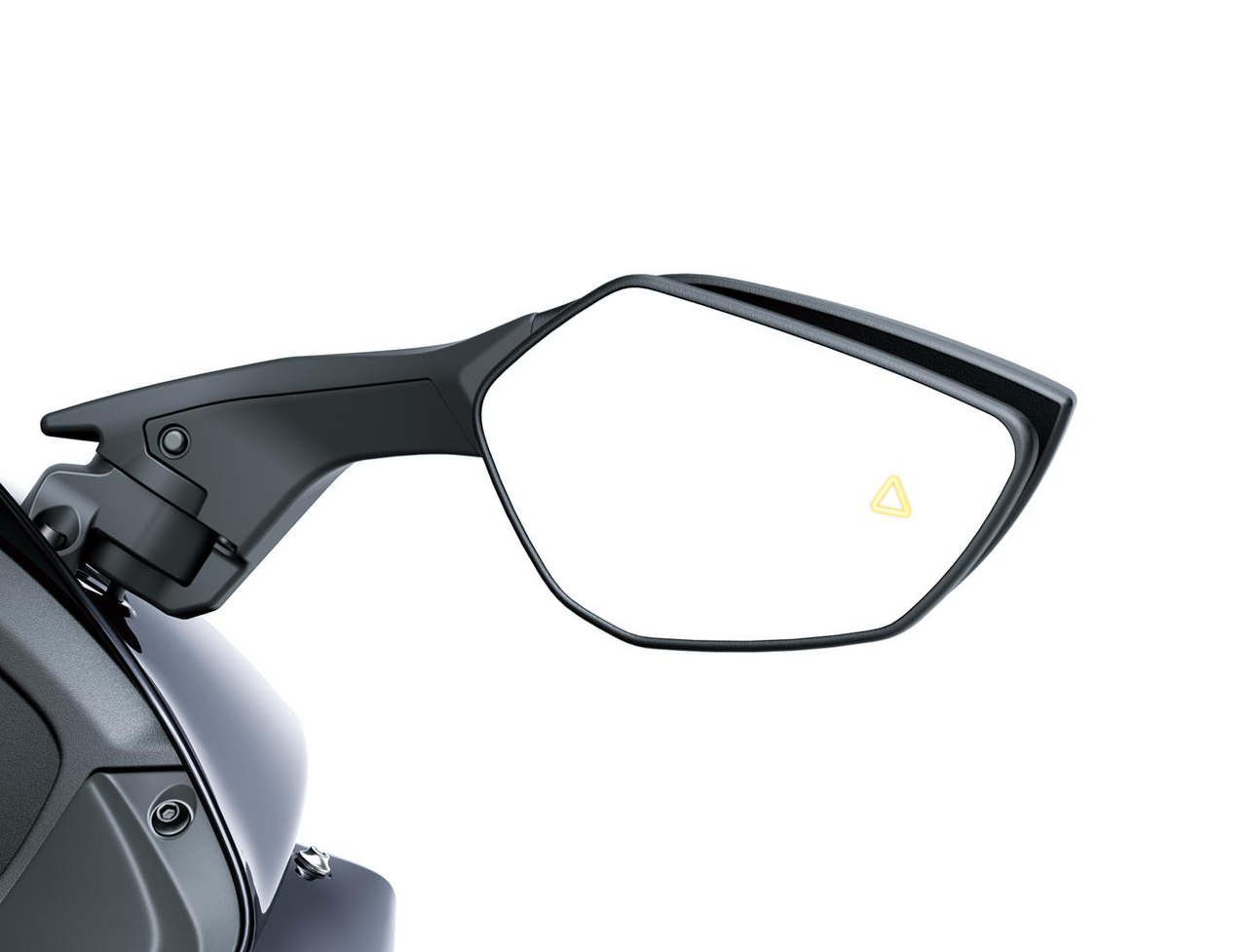
BSD (Blind-Spot Detection)
The rear-facing radar sensor monitors the bike’s surroundings and alerts the rider to presence of a vehicle approaching in the rider’s blind spot.
BSD (Blind-Spot Detection)
The rear-facing radar sensor monitors the bike’s surroundings and alerts the rider to presence of a vehicle approaching in the rider’s blind spot.
FCW (Forward Collision Warning)
When the system determines that continuing at the current speed may result in a collision with the vehicle in front, it warns the rider.
FCW (Forward Collision Warning)
When the system determines that continuing at the current speed may result in a collision with the vehicle in front, it warns the rider.
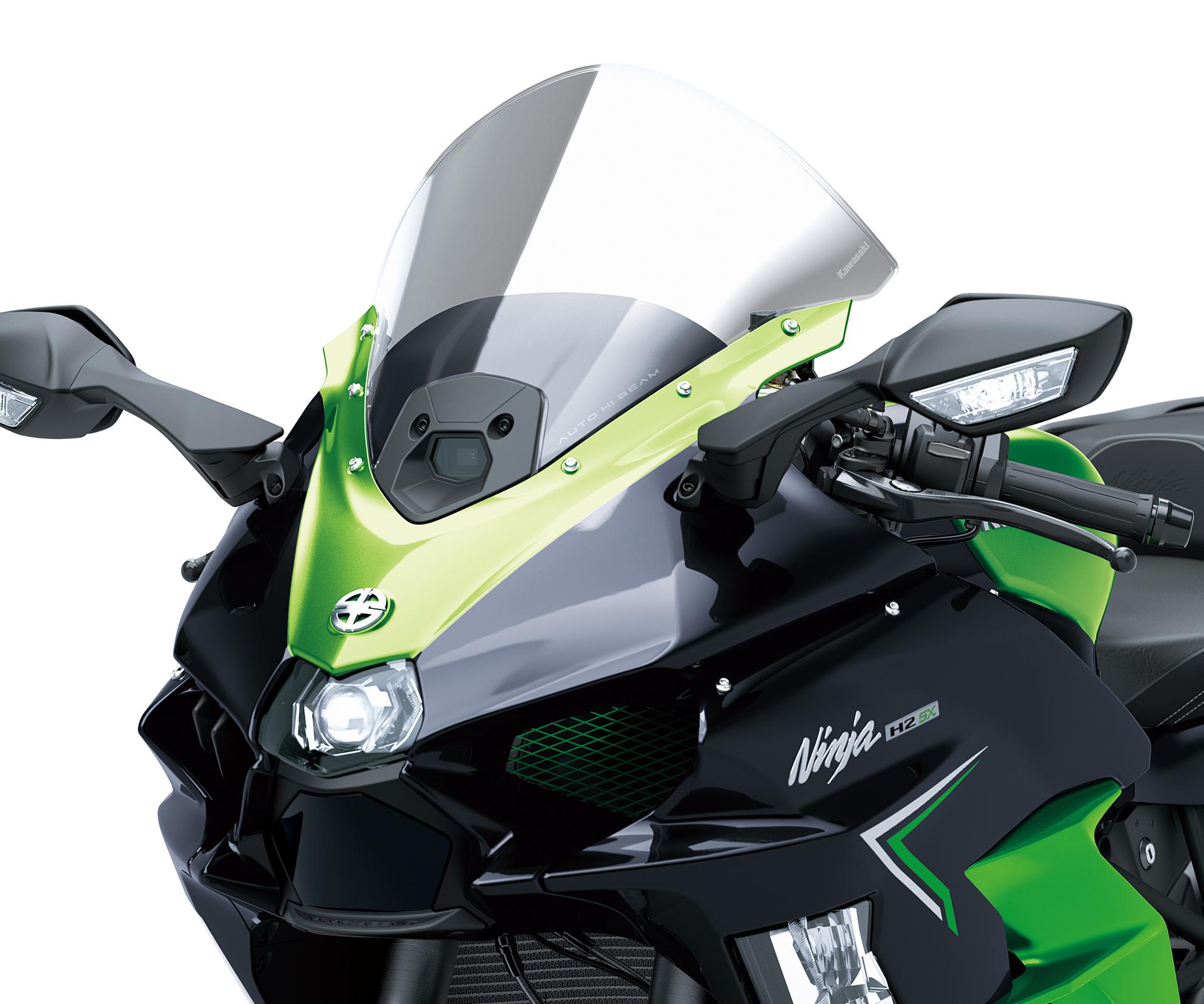
Wind Protection & Aerodynamics
With its large windshield and full-fairing bodywork, the Ninja H2 SX provides substantial wind protection, contributing to rider comfort on long rides. In addition to contributing to sporty styling, the aerodynamically shaped bodywork is also a benefit when riding at highway speeds.
Wind Protection & Aerodynamics
With its large windshield and full-fairing bodywork, the Ninja H2 SX provides substantial wind protection, contributing to rider comfort on long rides. In addition to contributing to sporty styling, the aerodynamically shaped bodywork is also a benefit when riding at highway speeds.
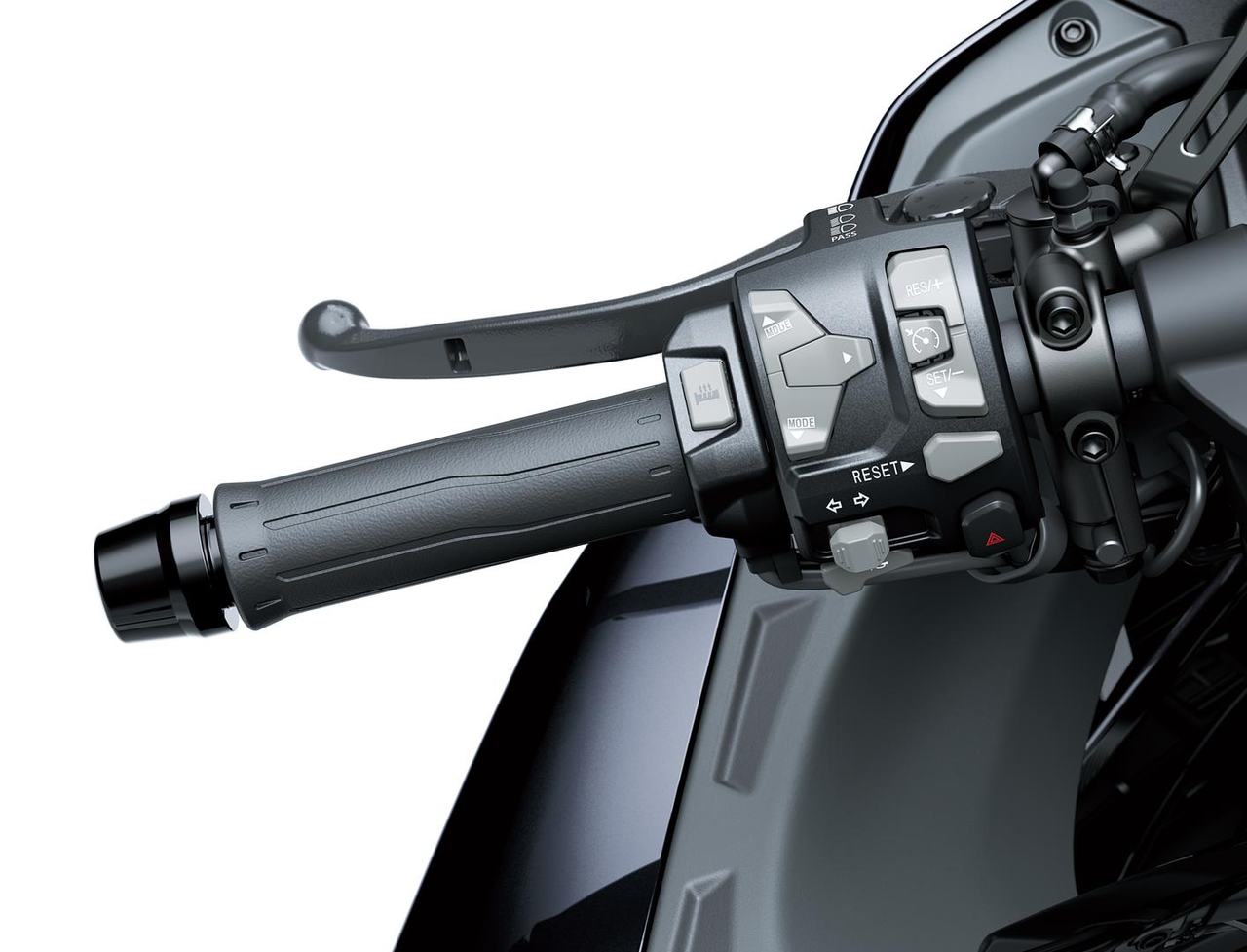
ACC (Adaptive Cruise Control)
A more advanced version of Electronic Cruise Control, ACC maintains the speed set by the rider, but adjusts the vehicle speed to maintain a suitable following distance from the vehicle in front.
ACC (Adaptive Cruise Control)
A more advanced version of Electronic Cruise Control, ACC maintains the speed set by the rider, but adjusts the vehicle speed to maintain a suitable following distance from the vehicle in front.
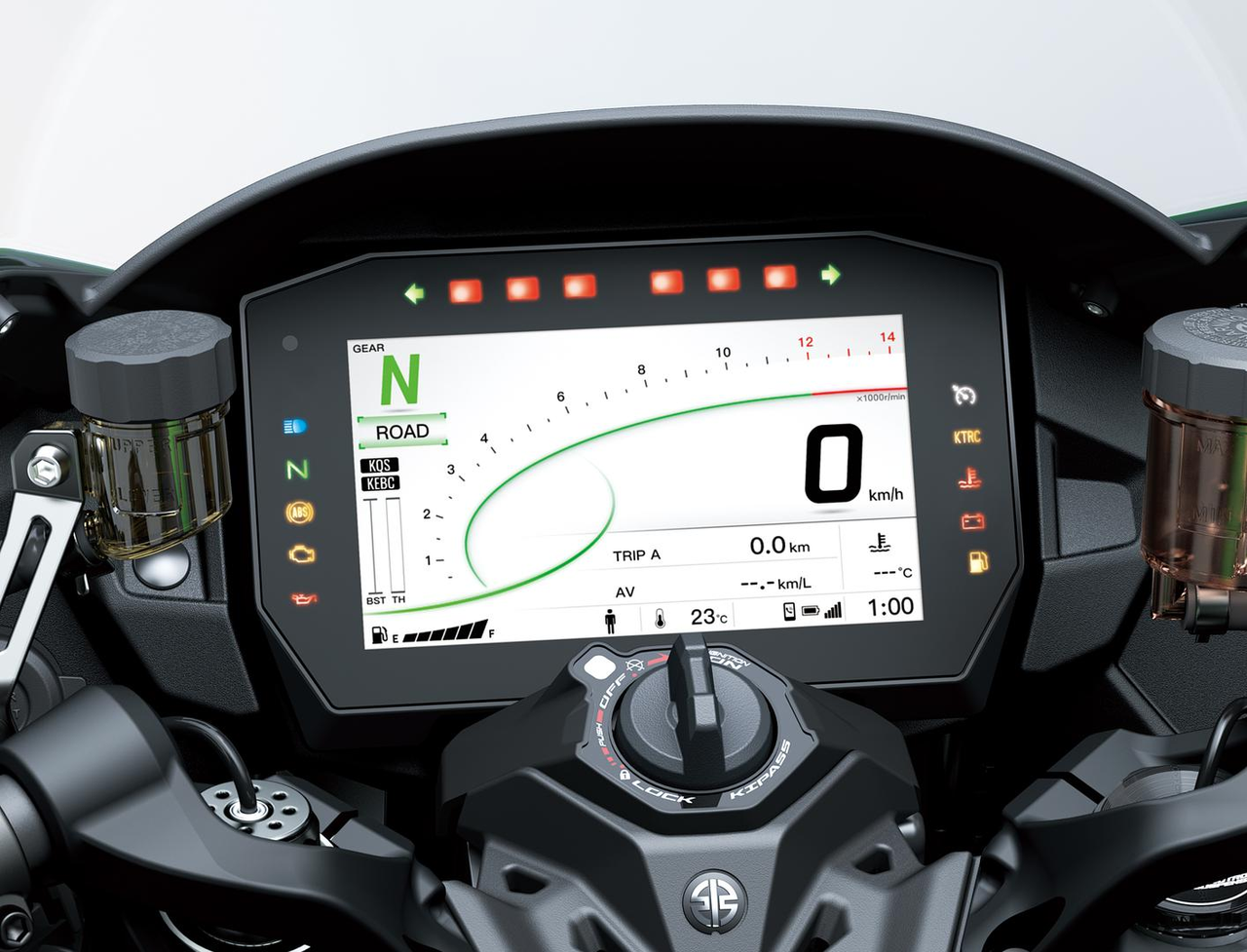
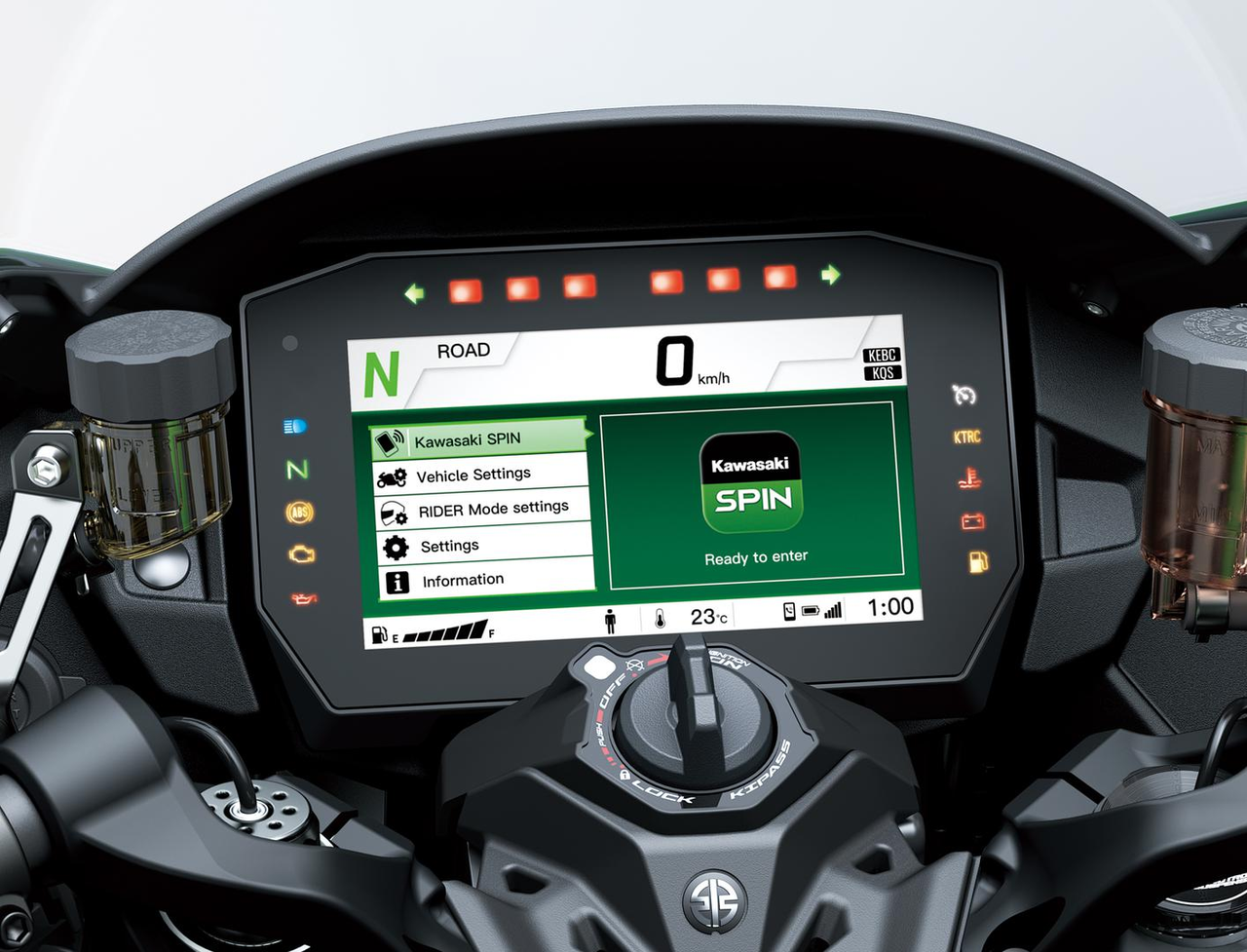
6.5” TFT Colour Instrumentation
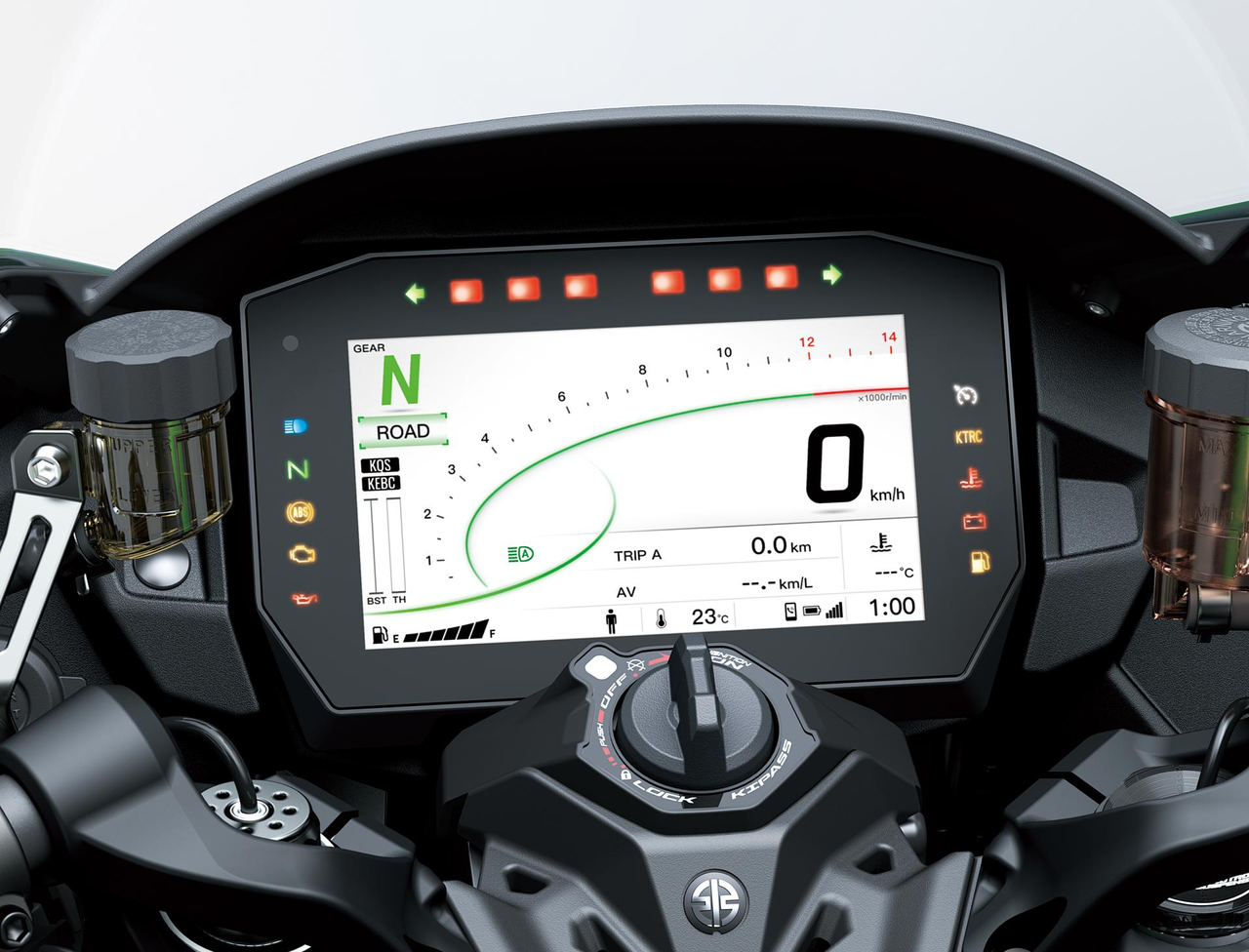
Large, easy-to-read 6.5” full-colour TFT instrumentation adds a high-tech touch to the cockpit. Complementing the multiple display modes and smartphone connectivity, compatibility with Kawasaki SPIN offers numerous infotainment possibilities.
6.5” TFT Colour Instrumentation
Large, easy-to-read 6.5” full-colour TFT instrumentation adds a high-tech touch to the cockpit. Complementing the multiple display modes and smartphone connectivity, compatibility with Kawasaki SPIN offers numerous infotainment possibilities.
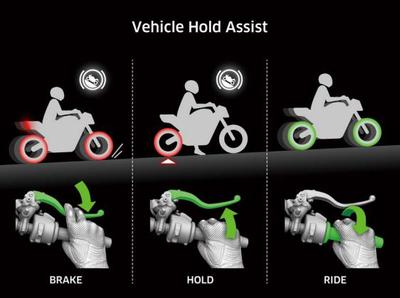
Vehicle Hold Assist (VHA)
Activated when the rider has stopped and firmly applies the brake(s), VHA engages the rear brake to allow the rider to relax their brake hand/foot.
Vehicle Hold Assist (VHA)
Activated when the rider has stopped and firmly applies the brake(s), VHA engages the rear brake to allow the rider to relax their brake hand/foot.
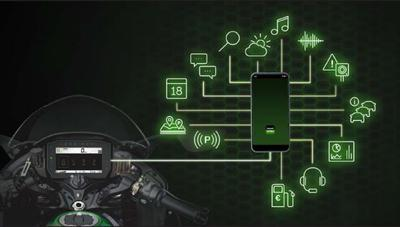
Kawasaki SPIN
Kawasaki’s new smartphone-based infotainment app enables various third-party applications to be downloaded and displayed on the cockpit’s TFT display.
Kawasaki SPIN
Kawasaki’s new smartphone-based infotainment app enables various third-party applications to be downloaded and displayed on the cockpit’s TFT display.
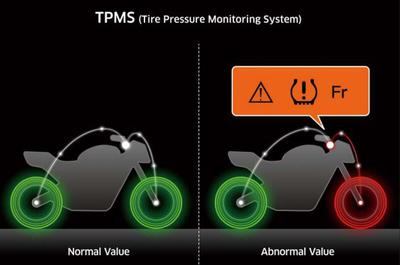
Tyre Pressure Monitoring System (TPMS)
TPMS continuously monitors tyre air pressure while riding, adding to rider reassurance on long tours.
Tyre Pressure Monitoring System (TPMS)
TPMS continuously monitors tyre air pressure while riding, adding to rider reassurance on long tours.
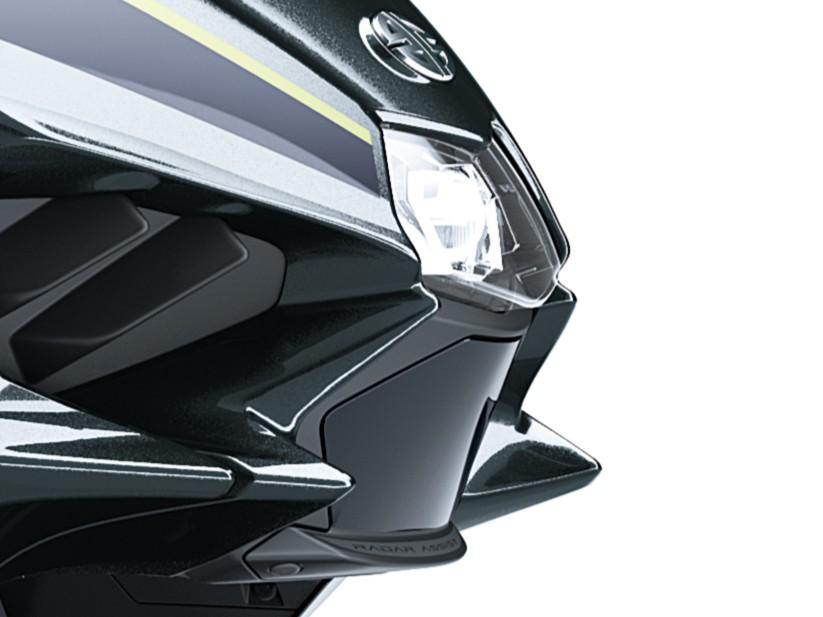
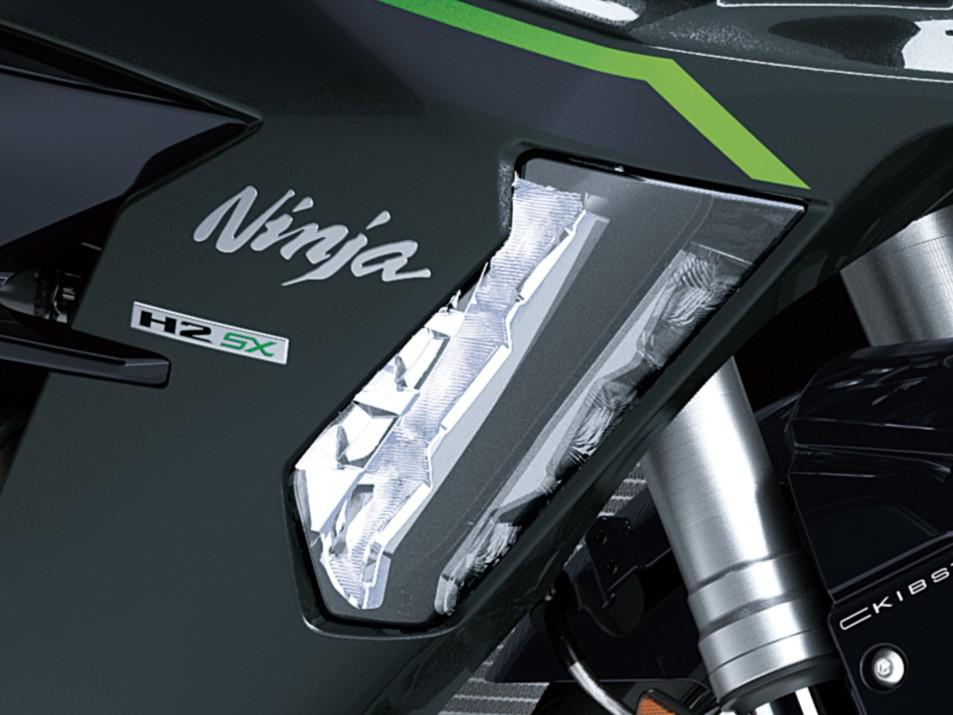
LED Cornering Lights
Lean-activated lights built into the fairings help illuminate the road when cornering.
LED Cornering Lights
Lean-activated lights built into the fairings help illuminate the road when cornering.
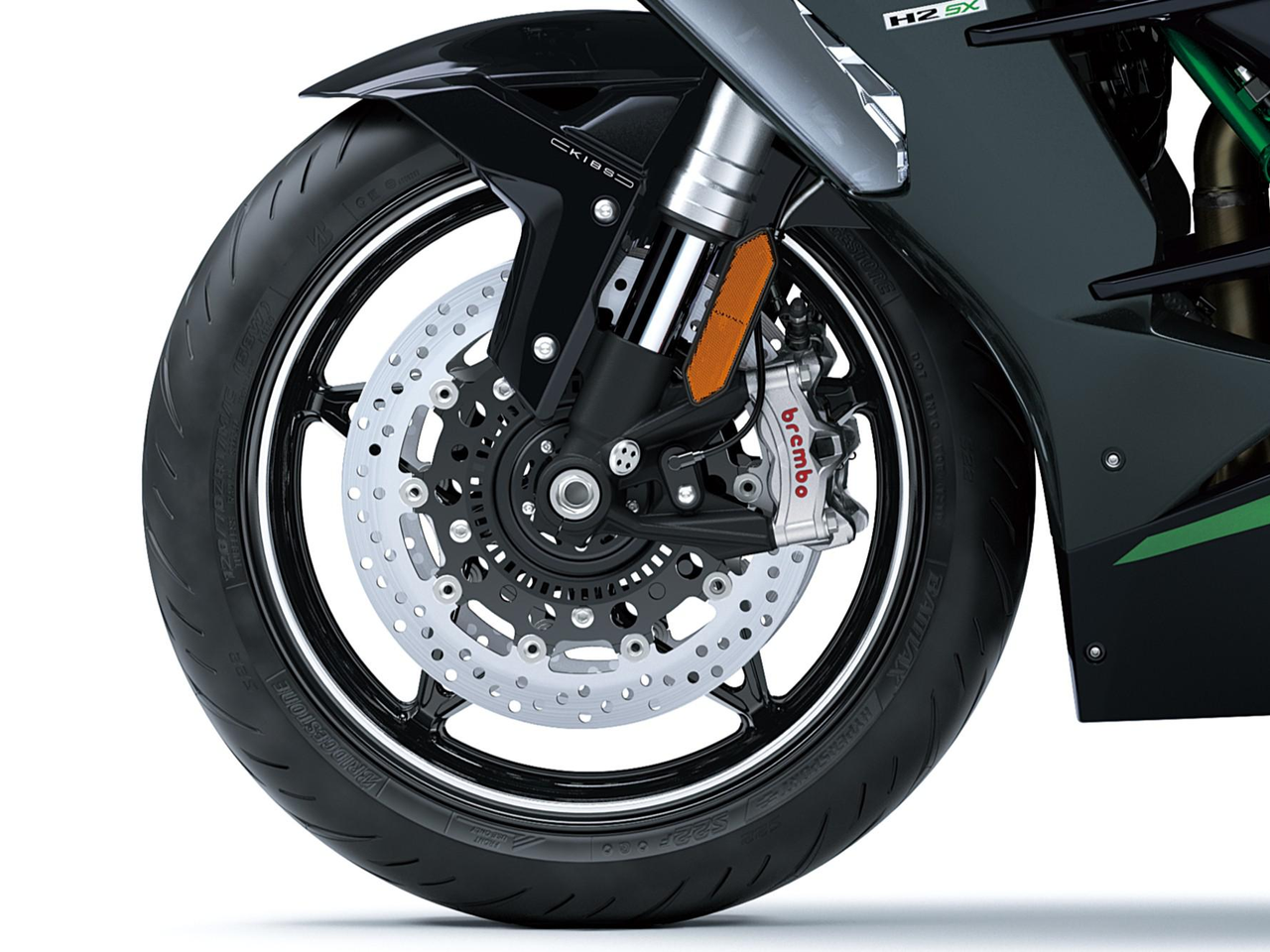
Brembo Stylema Monobloc Calipers (SE)
On the SE model, high-spec Brembo Stylema monobloc calipers offer enhanced control. The compact, lightweight calipers minimise the internal space taken up by fluid, enabling a more direct response. Stylema calipers cool very rapidly thanks to a design that promotes airflow around the brake pads, space around the pistons, and an opening that allows air to exit from the central bridge.
Brembo Stylema Monobloc Calipers (SE)
On the SE model, high-spec Brembo Stylema monobloc calipers offer enhanced control. The compact, lightweight calipers minimise the internal space taken up by fluid, enabling a more direct response. Stylema calipers cool very rapidly thanks to a design that promotes airflow around the brake pads, space around the pistons, and an opening that allows air to exit from the central bridge.
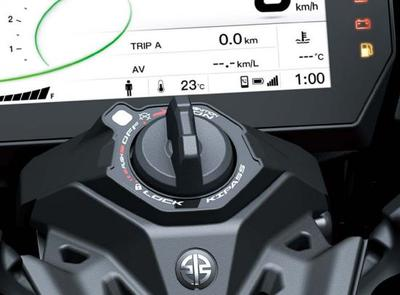
KIPASS
KIPASS (Kawasaki’s Intelligent Proximity Activation Start System) master key system allows remote activation of the bike’s main switch and steering lock.
KIPASS
KIPASS (Kawasaki’s Intelligent Proximity Activation Start System) master key system allows remote activation of the bike’s main switch and steering lock.
Advanced Rider Assistance Systems (ARAS)
Bosch’s radar-based ARAS systems made their Japanese mass-production motorcycle debut on the Ninja H2 SX. These surround sensing technology features help add to rider reassurance while touring or riding in heavy traffic.
Advanced Rider Assistance Systems (ARAS)
Bosch’s radar-based ARAS systems made their Japanese mass-production motorcycle debut on the Ninja H2 SX. These surround sensing technology features help add to rider reassurance while touring or riding in heavy traffic.
Comfortable Seating for Two
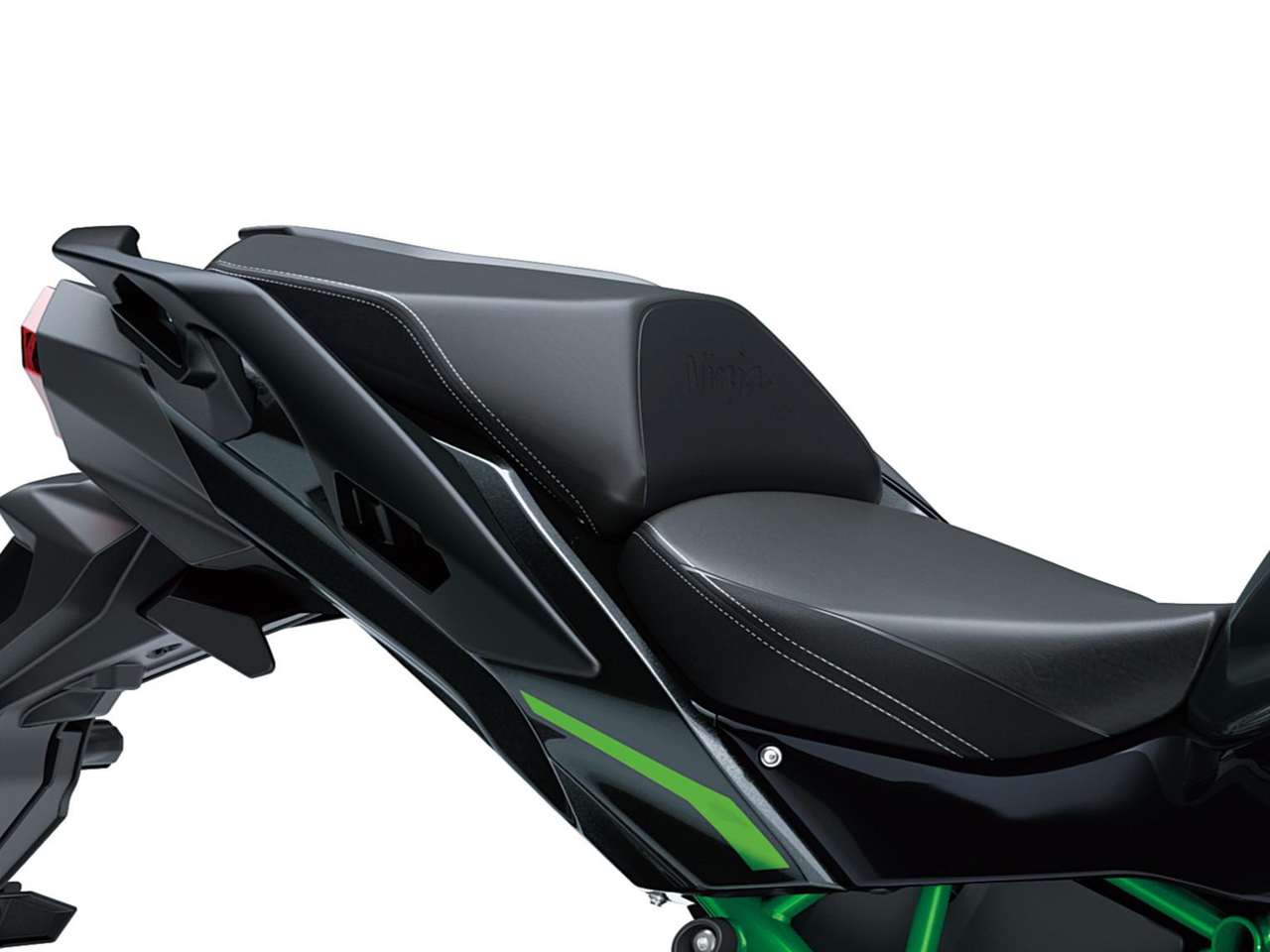
Ergonomically designed front seat both provides comfort for spending long hours in the saddle, and accommodates position changes for sportier riding. Both rider and passenger seats are wider than previous, and revised shapes, thickness and density add to rider and passenger comfort.
Comfortable Seating for Two
Ergonomically designed front seat both provides comfort for spending long hours in the saddle, and accommodates position changes for sportier riding. Both rider and passenger seats are wider than previous, and revised shapes, thickness and density add to rider and passenger comfort.
Clean-Mount Pannier System
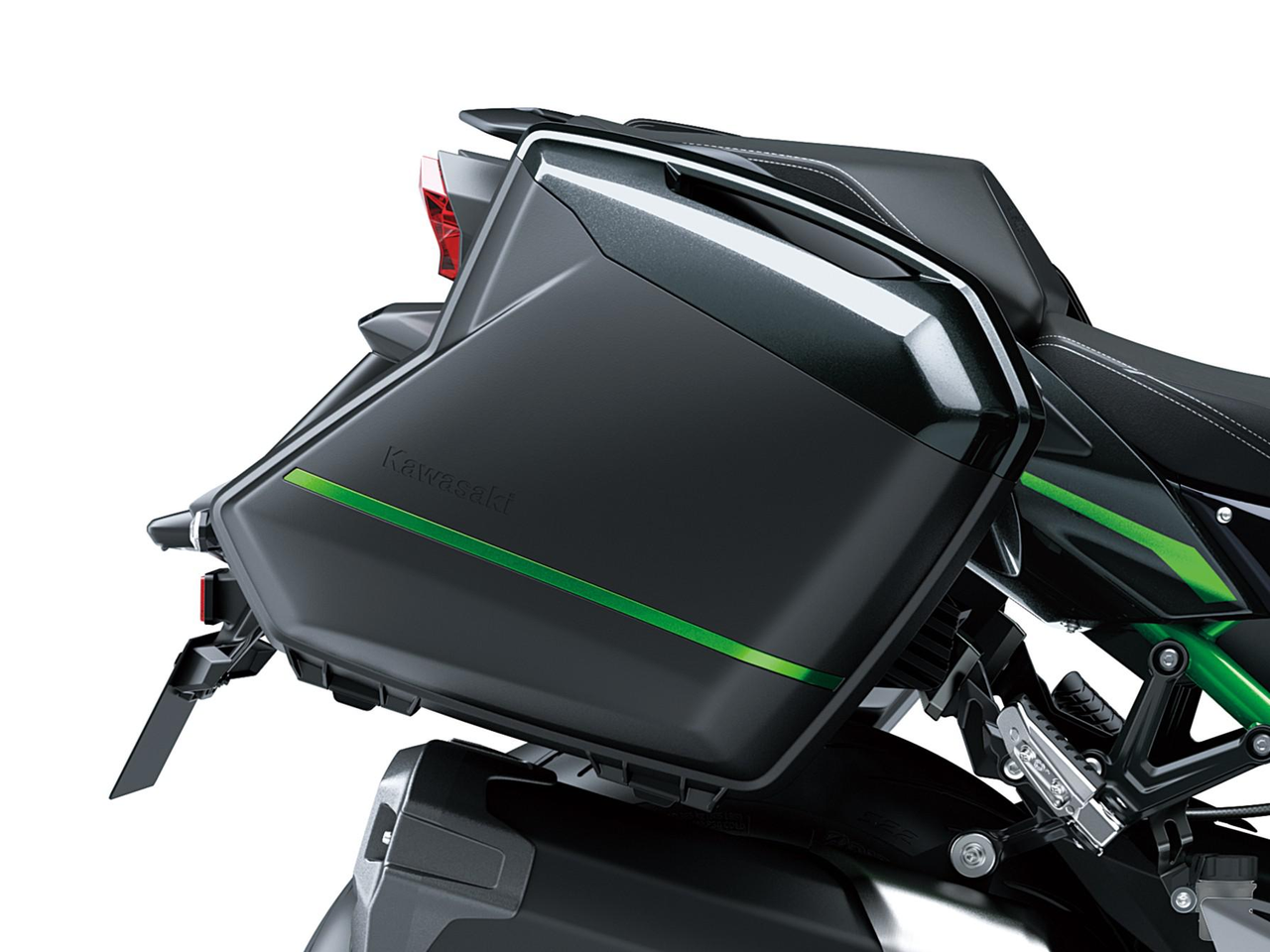
Attaching and removing the accessory panniers is simple and convenient thanks to the mounting system. When mounted, the panniers integrate seamlessly with the rear of the bike; when removed, the clutter-free design ensures the rear of the bike looks good.

Clean-Mount Pannier System
Attaching and removing the accessory panniers is simple and convenient thanks to the mounting system. When mounted, the panniers integrate seamlessly with the rear of the bike; when removed, the clutter-free design ensures the rear of the bike looks good.
- KECS with Skyhook
- Supercharged Sport Touring
- Flagship Convenience Features
- Leading-Edge Technology
- Balanced Supercharged Engine
- Kawasaki Rider Support Technology
- Auto High Beam (AHB)
- Emergency Stop Signal (ESS)
- BSD (Blind-Spot Detection)
- FCW (Forward Collision Warning)
- Wind Protection & Aerodynamics
- ACC (Adaptive Cruise Control)
- 6.5” TFT Colour Instrumentation
- Vehicle Hold Assist (VHA)
- Kawasaki SPIN
- Tyre Pressure Monitoring System (TPMS)
- LED Cornering Lights
- Brembo Stylema Monobloc Calipers (SE)
- KIPASS
- Advanced Rider Assistance Systems (ARAS)
- Comfortable Seating for Two
- Clean-Mount Pannier System
KECS with Skyhook
KECS, Kawasaki’s semi-active electronic suspension system, adapts to road and riding conditions in real time, providing the ideal amount of damping called for. Updated software incorporates Skyhook technology to deliver an even more composed ride, contributing to increased comfort and enjoyment.
KECS with Skyhook
KECS, Kawasaki’s semi-active electronic suspension system, adapts to road and riding conditions in real time, providing the ideal amount of damping called for. Updated software incorporates Skyhook technology to deliver an even more composed ride, contributing to increased comfort and enjoyment.
Supercharged Sport Touring
Originally conceived to be the fastest sport tourer on the Autobahn, the Ninja H2 SX offers a unique riding experience. With supercharged acceleration and the equipment to cover long distances in comfort, Kawasaki’s supercharged sport tourer will have riders smiling in their helmets as they eat up the miles.
Supercharged Sport Touring
Originally conceived to be the fastest sport tourer on the Autobahn, the Ninja H2 SX offers a unique riding experience. With supercharged acceleration and the equipment to cover long distances in comfort, Kawasaki’s supercharged sport tourer will have riders smiling in their helmets as they eat up the miles.
Flagship Convenience Features
Befitting a flagship model, the Ninja H2 SX features large, full colour instrumentation in addition to a host of high-grade convenience features including KIPASS and TPMS.
Flagship Convenience Features
Befitting a flagship model, the Ninja H2 SX features large, full colour instrumentation in addition to a host of high-grade convenience features including KIPASS and TPMS.
Leading-Edge Technology
The Ninja H2 SX is Kawasaki’s first model to integrate an FI-ECU with torque-demand capabilities; new IMU that measures in six DOF; and boost-circuit-equipped ABS with high computational power, enabling coordinated chassis control. Equipped with Bosch’s Advanced Rider Assistance Systems and (on the SE model) Showa’s Skyhook Technology, the Ninja H2 SX is Kawasaki’s most advanced model to date.
Leading-Edge Technology
The Ninja H2 SX is Kawasaki’s first model to integrate an FI-ECU with torque-demand capabilities; new IMU that measures in six DOF; and boost-circuit-equipped ABS with high computational power, enabling coordinated chassis control. Equipped with Bosch’s Advanced Rider Assistance Systems and (on the SE model) Showa’s Skyhook Technology, the Ninja H2 SX is Kawasaki’s most advanced model to date.
Balanced Supercharged Engine
Designed to offer both power and fuel efficiency, the Balanced Supercharged Engine delivers a maximum power of 200 PS. Tuning focused on the low-mid range prioritises everyday usability in street-riding situations over outright performance, and helps to achieve fuel efficiency exceeding that of the Ninja 1000SX and Versys 1000.
Balanced Supercharged Engine
Designed to offer both power and fuel efficiency, the Balanced Supercharged Engine delivers a maximum power of 200 PS. Tuning focused on the low-mid range prioritises everyday usability in street-riding situations over outright performance, and helps to achieve fuel efficiency exceeding that of the Ninja 1000SX and Versys 1000.
Kawasaki Rider Support Technology
Kawasaki’s highly sophisticated electronic management systems offer rider support to allow them to more fully experience how the Ninja H2 SX is fun and rewarding to control.
Kawasaki Rider Support Technology
Kawasaki’s highly sophisticated electronic management systems offer rider support to allow them to more fully experience how the Ninja H2 SX is fun and rewarding to control.
Auto High Beam (AHB)
Using a camera sensor to assess the brightness of the lights of vehicles ahead, of streetlights, etc. AHB automatically turns the bike’s high beams on or off as necessary. For the system to function, the dimmer/passing switch must be set to high beam, the bike must be travelling above 20 km/h, and it must be dark. When the system has been engaged, the icon displayed on the instrument screen will show green.
Auto High Beam (AHB)
Using a camera sensor to assess the brightness of the lights of vehicles ahead, of streetlights, etc. AHB automatically turns the bike’s high beams on or off as necessary. For the system to function, the dimmer/passing switch must be set to high beam, the bike must be travelling above 20 km/h, and it must be dark. When the system has been engaged, the icon displayed on the instrument screen will show green.
Emergency Stop Signal (ESS)
During hard braking, ESS causes the brake light to flash, calling attention to the bike’s quick deceleration.
Emergency Stop Signal (ESS)
During hard braking, ESS causes the brake light to flash, calling attention to the bike’s quick deceleration.
BSD (Blind-Spot Detection)
The rear-facing radar sensor monitors the bike’s surroundings and alerts the rider to presence of a vehicle approaching in the rider’s blind spot.
BSD (Blind-Spot Detection)
The rear-facing radar sensor monitors the bike’s surroundings and alerts the rider to presence of a vehicle approaching in the rider’s blind spot.
FCW (Forward Collision Warning)
When the system determines that continuing at the current speed may result in a collision with the vehicle in front, it warns the rider.
FCW (Forward Collision Warning)
When the system determines that continuing at the current speed may result in a collision with the vehicle in front, it warns the rider.
Wind Protection & Aerodynamics
With its large windshield and full-fairing bodywork, the Ninja H2 SX provides substantial wind protection, contributing to rider comfort on long rides. In addition to contributing to sporty styling, the aerodynamically shaped bodywork is also a benefit when riding at highway speeds.
Wind Protection & Aerodynamics
With its large windshield and full-fairing bodywork, the Ninja H2 SX provides substantial wind protection, contributing to rider comfort on long rides. In addition to contributing to sporty styling, the aerodynamically shaped bodywork is also a benefit when riding at highway speeds.
ACC (Adaptive Cruise Control)
A more advanced version of Electronic Cruise Control, ACC maintains the speed set by the rider, but adjusts the vehicle speed to maintain a suitable following distance from the vehicle in front.
ACC (Adaptive Cruise Control)
A more advanced version of Electronic Cruise Control, ACC maintains the speed set by the rider, but adjusts the vehicle speed to maintain a suitable following distance from the vehicle in front.
6.5” TFT Colour Instrumentation
Large, easy-to-read 6.5” full-colour TFT instrumentation adds a high-tech touch to the cockpit. Complementing the multiple display modes and smartphone connectivity, compatibility with Kawasaki SPIN offers numerous infotainment possibilities.
6.5” TFT Colour Instrumentation
Large, easy-to-read 6.5” full-colour TFT instrumentation adds a high-tech touch to the cockpit. Complementing the multiple display modes and smartphone connectivity, compatibility with Kawasaki SPIN offers numerous infotainment possibilities.
Vehicle Hold Assist (VHA)
Activated when the rider has stopped and firmly applies the brake(s), VHA engages the rear brake to allow the rider to relax their brake hand/foot.
Vehicle Hold Assist (VHA)
Activated when the rider has stopped and firmly applies the brake(s), VHA engages the rear brake to allow the rider to relax their brake hand/foot.
Kawasaki SPIN
Kawasaki’s new smartphone-based infotainment app enables various third-party applications to be downloaded and displayed on the cockpit’s TFT display.
Kawasaki SPIN
Kawasaki’s new smartphone-based infotainment app enables various third-party applications to be downloaded and displayed on the cockpit’s TFT display.
Tyre Pressure Monitoring System (TPMS)
TPMS continuously monitors tyre air pressure while riding, adding to rider reassurance on long tours.
Tyre Pressure Monitoring System (TPMS)
TPMS continuously monitors tyre air pressure while riding, adding to rider reassurance on long tours.
LED Cornering Lights
Lean-activated lights built into the fairings help illuminate the road when cornering.
LED Cornering Lights
Lean-activated lights built into the fairings help illuminate the road when cornering.
Brembo Stylema Monobloc Calipers (SE)
On the SE model, high-spec Brembo Stylema monobloc calipers offer enhanced control. The compact, lightweight calipers minimise the internal space taken up by fluid, enabling a more direct response. Stylema calipers cool very rapidly thanks to a design that promotes airflow around the brake pads, space around the pistons, and an opening that allows air to exit from the central bridge.
Brembo Stylema Monobloc Calipers (SE)
On the SE model, high-spec Brembo Stylema monobloc calipers offer enhanced control. The compact, lightweight calipers minimise the internal space taken up by fluid, enabling a more direct response. Stylema calipers cool very rapidly thanks to a design that promotes airflow around the brake pads, space around the pistons, and an opening that allows air to exit from the central bridge.
KIPASS
KIPASS (Kawasaki’s Intelligent Proximity Activation Start System) master key system allows remote activation of the bike’s main switch and steering lock.
KIPASS
KIPASS (Kawasaki’s Intelligent Proximity Activation Start System) master key system allows remote activation of the bike’s main switch and steering lock.
Advanced Rider Assistance Systems (ARAS)
Bosch’s radar-based ARAS systems made their Japanese mass-production motorcycle debut on the Ninja H2 SX. These surround sensing technology features help add to rider reassurance while touring or riding in heavy traffic.
Advanced Rider Assistance Systems (ARAS)
Bosch’s radar-based ARAS systems made their Japanese mass-production motorcycle debut on the Ninja H2 SX. These surround sensing technology features help add to rider reassurance while touring or riding in heavy traffic.
Comfortable Seating for Two
Ergonomically designed front seat both provides comfort for spending long hours in the saddle, and accommodates position changes for sportier riding. Both rider and passenger seats are wider than previous, and revised shapes, thickness and density add to rider and passenger comfort.
Comfortable Seating for Two
Ergonomically designed front seat both provides comfort for spending long hours in the saddle, and accommodates position changes for sportier riding. Both rider and passenger seats are wider than previous, and revised shapes, thickness and density add to rider and passenger comfort.
Clean-Mount Pannier System
Attaching and removing the accessory panniers is simple and convenient thanks to the mounting system. When mounted, the panniers integrate seamlessly with the rear of the bike; when removed, the clutter-free design ensures the rear of the bike looks good.

Clean-Mount Pannier System
Attaching and removing the accessory panniers is simple and convenient thanks to the mounting system. When mounted, the panniers integrate seamlessly with the rear of the bike; when removed, the clutter-free design ensures the rear of the bike looks good.
Supercharged engine
Designed completely in-house, the immense potential of the highly compact, highly efficient supercharged engine is a testament to the technology possessed by the KHI Group.
Supercharged engine
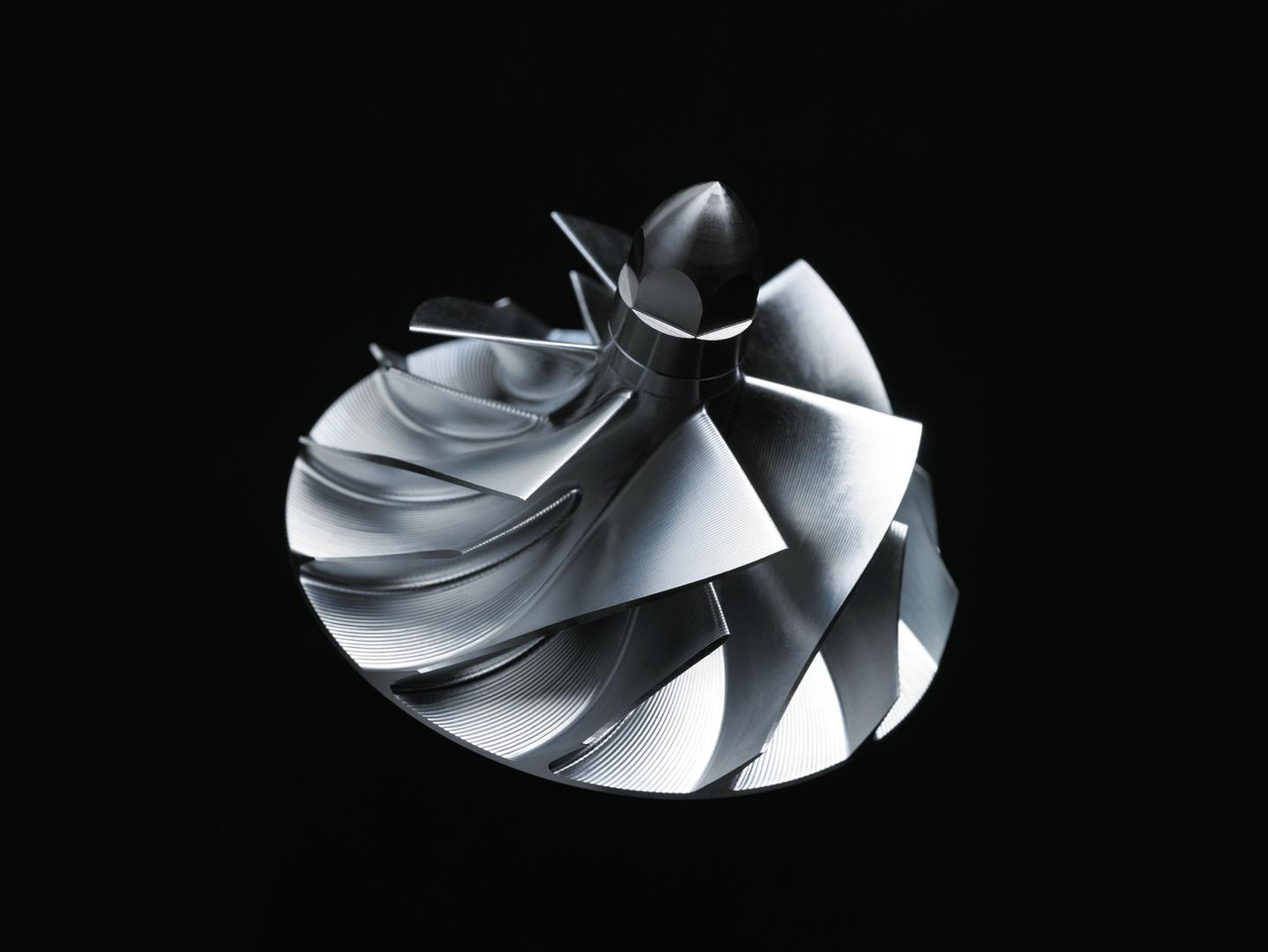
Drawing on the know-how and technology possessed by the KHI Group, Kawasaki’s supercharged engine delivers high engine output while maintaining a compact design. The key to achieving this incredible performance lies in the engine’s supercharger – a motorcycle-specific unit designed completely in-house with technology from Kawasaki’s Gas Turbine & Machinery Company, Aerospace Company and Corporate Technology Division.
One of the greatest benefits of designing the supercharger in-house and tailoring its design to match the engine’s characteristics was that engineers were able to achieve high-efficiency operation over a wide range of conditions – something that would not have been possible by simply dropping in or trying to adapt an aftermarket automotive supercharger.
The importance of high efficiency in a supercharger is that, as the air is compressed, power-robbing heat gain is minimal. And while many superchargers are able to offer high-efficiency operation in a very limited range of conditions, Kawasaki’s supercharger offers high efficiency over a wide range of pressure ratios and flow rates – meaning over a wide range of engine speeds and vehicle speeds. This wide range of efficient operation (similar to having a wide power band) easily translates to strong acceleration. The supercharger’s high efficiency and minimal heat gain also meant that an intercooler was unnecessary, greatly saving weight and space, and enabling the engine’s compact design.
KECS - Kawasaki Electronic Control Suspension
KECS (Kawasaki Electronic Control Suspension) adapts to road and riding conditions in real time, providing the ideal amount of damping called for.
KECS - Kawasaki Electronic Control Suspension
KECS adapts to road and riding conditions in real time, providing the ideal amount of damping called for by electronically adjusting damping to suit vehicle speed and suspension stroke speed. Deceleration is also taken into account, which allows the system to help manage pitching that may occur during braking.
Control via solenoid valve with direct actuation enables an extremely quick reaction time, making KECS ideal for sport riding applications, where natural feeling is crucial to feeling at one with the bike. Built-in stroke sensors on both the fork and rear shock provide real-time stroke speed and compression information. Input from the sensor coils to the KECS ECU is complemented by information provided by the IMU (acceleration/deceleration) and the FI ECU (vehicle speed). The KECS ECU then directs current to the solenoids to adjust damping as required by the situation.
Selectable modes allow riders to choose softer or firmer base settings.
IMU - Inertial Measurement Unit
Combined with Kawasaki’s proprietary dynamic modelling program, input from the IMU (Inertial Measurement Unit) enables even more precise chassis orientation awareness, the key to bringing Kawasaki’s electronics to the next level.
IMU - Inertial Measurement Unit
IMU means Enhanced Chassis Orientation Awareness. The strength of Kawasaki's cutting-edge electronics has always been the highly sophisticated programming that, using minimal hardware, gives the ECU an accurate real-time picture of what the chassis is doing. Kawasaki's proprietary dynamic modelling program makes skillful use of the magic formula tyre model as it examines changes in multiple parameters, enabling it to take into account changing road and tyre conditions. The addition of an IMU (Inertial Measurement Unit) enables inertia along 6 DOF (degrees of freedom) to be monitored. Acceleration along longitudinal, transverse and vertical axes, plus roll rate and pitch rate are measured. The yaw rate is calculated by the ECU. This additional feedback contributes to an even clearer real-time picture of chassis orientation, enabling even more precise management for control at the limit. With the addition of the IMU and the latest evolution of Kawasaki's advanced modelling software, Kawasaki's electronic engine and chassis management technology takes the step to the next level changing from setting-type and reaction-type systems to feedback-type systems to deliver even greater levels of riding excitement.
KIPASS
KIPASS (Kawasaki’s Intelligent Proximity Activation Start System) is a master key system that allows remote activation of the bike’s main switch and steering lock.
KIPASS
With the compact key fob (portable immobiliser) in a pocket, KIPASS allows riders to remotely release the bike's steering lock and main switch simply by approaching the bike. When the fob key is close to the bike, the signal it sends out is picked up and recognised by the KIPASS unit in the bike. Like immobiliser keys, each fob key has a unique signal, making this system also useful as a theft deterrent. The fob key can be recognised when in a jacket pocket, so there is no need for the rider to remove the key to operate the bike's main switch. Pannier cases and fuel tank cap are opened using the knob key inside the key cylinder. Because the knob key cannot be removed when the key fob is out of range, the keyhole is never visible, helping to prevent tampering. This system uses the encryption algorithm "MISTY" developed by MITSUBISHI ELECTRIC CORPORATION.
KLCM
KLCM (Kawasaki Launch Control Mode) optimises acceleration from a stop by electronically managing engine output to prevent wheelspin.
KLCM
Designed to assist riders by optimising acceleration from a stop, KLCM electronically manages engine output to prevent wheelspin when moving off. Riders can choose from three modes, each offering a progressively greater level of intrusion. Each mode allows the rider to leave from a stop with the throttle held wide open. With the clutch lever pulled in and the system activated, engine speed is limited to a determined speed while the rider holds the throttle open. Once the rider releases the clutch lever to engage the clutch, engine speed is allowed to increase, but power is regulated to prevent wheelspin and help keep the front wheel on the ground. (In Mode 1, the least intrusive, the front wheel may lift a little.) The system disengages automatically at 150 km/h or when the rider shifts into 3rd gear.
KEBC
KEBC (Kawasaki Engine Brake Control) allows riders to select their preferred amount of engine braking.
KEBC
Engine braking can be used advantageously to help a bike decelerate, but not all riders prefer strong engine braking. With KEBC, riders are able to select the amount of engine braking they prefer. When KEBC is activated, the engine braking effect is reduced, providing less interference when riding on the circuit.
Tyre Pressure Monitoring System
The Tyre Pressure Monitoring System (TPMS) continuously monitors tyre air pressure while riding, adding to rider reassurance on long tours.
Tyre Pressure Monitoring System
Maintaining the correct tyre air pressure is very important as it can greatly affect a motorcycle's handling, and riding with low tyre pressure, due to a puncture, leak or other, increases the risk of a tyre bursting. Tyre air escapes naturally over time, so it is also important to check tyre pressure regularly. The Tyre Pressure Monitoring System continuously measures tyre pressure (using sensors attached to the air valves of each wheel) and displays the current pressure on the bike's instrument panel while riding. Tyre air pressure varies greatly as the tyres warm up, but the Tyre Pressure Monitoring System takes this into consideration and recalculates the pressure for 20? to avoid confusion and false warnings. When tyre air pressure is excessively low, a tyre mark appears on the display, warning the rider. On the 1400GTR / Concours 14, recommended pressure for both the front and rear wheels is 290 kPa (approximately 2.9 kgf/cm2). Should the pressure fall below 220 kPa (approximately 2.2 kgf/cm2), the warning mark will appear. Not only does this system eliminate the hassle of manually checking tyre pressure on long tours, it quickly lets the rider know of any sudden pressure loss due to, say, a punctured tyre.
KCMF - Kawasaki Cornering Management Function
KCMF (Kawasaki Cornering Management Function) monitors engine and chassis parameters throughout the corner.
KCMF - Kawasaki Cornering Management Function
KCMF monitors engine and chassis parameters throughout the corner from entry, through the apex, to corner exit modulating brake force and engine power to facilitate smooth transition from acceleration to braking and back again, and to assist riders in tracing their intended line through the corner. KCMF oversees the following systems (where available): KTRC (including traction, wheelie and sliding control), KIBS (including pitching control), Kawasaki Engine Brake Control
KQS - Kawasaki Quick Shifter
Designed to help riders maximise their acceleration on the circuit by enabling clutchless upshifts with the throttle fully open, KQS detects that the shift lever has been actuated and sends a signal to the ECU to cut ignition so that the next gear can be engaged without having to use the clutch. On models that offer clutchless downshifts, during deceleration the system automatically controls engine speed so that the next lower gear can be selected without operating the clutch.
KIBS
KIBS (Kawasaki Intelligent anti-lock Brake System) is a high-precision brake system designed specifically for supersport models, offering highly efficient braking while maintaining natural feel.
KIBS
Kawasaki developed KIBS to take into account the particular handling characteristics of supersport motorcycles, ensuring highly efficient braking with minimal intrusion during hard sport riding. It is the first mass-production brake system to link the ABS ECU (Electronic Control Unit) and engine ECU. In addition front and rear wheel speed, KIBS monitors front brake caliper hydraulic pressure, throttle position, engine speed, clutch actuation and gear position. This diverse information is analysed to determine the ideal front brake hydraulic pressure. Through precise control, the large drops in hydraulic pressure seen on standard ABS systems can be avoided. Additionally, the tendency on supersport models for the rear wheel to lift under heavy braking can be suppressed and rear brake controllability can be maintained when downshifting.
ACC
ACC (Adaptive Cruise Control) maintains the speed set by the rider, but adjusts the vehicle speed to maintain a suitable following distance from the vehicle in front.
ACC
ACC (Adaptive Cruise Control) maintains the speed set by the rider, but adjusts the vehicle speed to maintain a suitable following distance from the vehicle in front. A more advanced version of Electronic Cruise Control, ACC maintains the speed set by the rider, but adjusts the vehicle speed to maintain a suitable following distance from the vehicle in front. A front-facing radar sensor uses millimetre-wave radar to scan ahead in the rider’s lane. The system takes into account the proximity of the vehicle ahead, degree of road slope, front/rear wheel speed, and the rider-selected distance setting (Near, Medium, or Far). When the distance to the vehicle in front is deemed insufficient, the system directs speed to be reduced. When the necessary decrease in speed is not great, this can be accomplished with engine braking; when stronger deceleration is required, the system also activates the brakes. Once more space becomes available, the system directs speed to be increased and the throttle is increased to return to the set speed.
FCW
FCW (Forward Collision Warning) warns the rider when the system determines that continuing at the current speed may result in a collision with the vehicle in front.
FCW
FCW (Forward Collision Warning) warns the rider when the system determines that continuing at the current speed may result in a collision with the vehicle in front. When the system determines that continuing at the current speed may result in a collision with the vehicle in front, it warns the rider. A front-facing radar sensor monitors the distance and speed of the vehicle in front. When a vehicle is in close proximity and there is danger of a collision should the current speed be maintained, the system alerts the rider using a bright flashing red LED light above the instrument panel. A warning is also shown on the TFT display. Riders can set the alert timing according to preference: Early, Medium, Late.
VHA
Activated when the rider has stopped and firmly applies the brake(s), VHA (Vehicle Hold Assist) engages the rear brake to allow the rider to relax their brake hand/foot.
VHA
Activated when the rider has stopped and firmly applies the brake(s), VHA engages the rear brake to allow the rider to relax their brake hand/foot. In addition to brake fluid pressure, the system examines the degree of road slope, front/rear wheel speed, throttle position, and side stand switch to determine whether operation conditions have been met. When the rider has stopped, VHA is initiated after the rider exerts a given amount of pressure (to either the front and/or rear brake). The ABS pump exerts pressure to engage the rear brake, and a light/signal is indicated on the instrument panel to let the rider know that they can relax their brake hand (and foot) and the bike will remain in place. The system disengages automatically when the rider turns the throttle to accelerate, when the side stand goes down, or 10 minutes after activation. The rider can also disengage the system by quickly squeezing and releasing the brake lever (for less than 1 second).
ESS
ESS (Emergency Stop Signal) causes the brake light to flash during hard braking, calling attention to the bike’s quick deceleration.
ESS
ESS (Emergency Stop Signal) causes the brake light to flash during hard braking, calling attention to the bike’s quick deceleration. During hard braking, ESS causes the brake light to flash – a visual clue to following vehicles calling attention to the bike’s quick deceleration.
Cornering Lights
Cornering lights provide supplemental illumination when cornering, creating a wider illuminated path in the direction the bike is heading.
Cornering Lights
Sets of three LED lights built into each side of the fairing help illuminate the road when cornering at night. Each of the three lights has a fixed direction and is activated based on lean angle. As the bike leans over, the lightscome on in order, creating a wider illuminated path in the direction the bike is heading.
SPIN
Kawasaki SPIN is a smartphone-based infotainment app that enables various third-party applications to be downloaded and mirrored on the cockpit’s TFT display.
SPIN
Kawasaki SPIN is a smartphone-based infotainment app that enables various third-party applications to be downloaded and mirrored on the cockpit’s TFT display. Kawasaki’s new smartphone-based infotainment app enables various third-party applications to be downloaded and mirrored on the cockpit’s TFT display. Basic functions available in the app include telephone, map display, music, calendar, and contacts. Additionally, riders can opt to download third-party apps to add to their Kawasaki SPIN library to be able to interact with them on the TFT display.
BSD
BSD (Blind-Spot Detection) monitors the bike’s surroundings and alerts the rider to presence of a vehicle approaching in the rider’s blind spot.
BSD
BSD (Blind-Spot Detection) monitors the bike’s surroundings and alerts the rider to presence of a vehicle approaching in the rider’s blind spot. Using a rear-facing radar sensor, BSD monitors the bike’s surroundings and alerts the rider to presence of a vehicle approaching in the rider’s blind spot. The rear-facing radar sensor scans behind in the lanes to the left and right of the rider. When an approaching vehicle is detected, an LED built into the rearview mirror will light up. (Note: BSD will not alert the rider to vehicles directly behind the bike, or vehicles that are moving away from the bike.) Should the rider indicate the intent to change lanes by switching on their turn signal while a vehicle is detected in a blind spot, the mirror LED will flash.
KTRC (3-mode)
3-Mode KTRC (Kawasaki TRaction Control), Kawasaki's most advanced traction control system, offers a selection of modes to suit a variety of riding situations, from sport riding to touring.
KTRC (3-mode)
3-mode KTRC combines the traction control technology of both 1-mode KTRC, which provides enhanced stability in slippery situations by preventing wheel slip, and S-KTRC, which helps maintain optimum traction in sport riding situations by predicting the rear wheel slip ratio during acceleration, into a single system. The convenient handle switch allows the type of traction control to be changed instantly by selecting one of the three modes, even while riding. Modes 1 and 2 maintain optimum traction during cornering, like S-KTRC. Designed with sport riding in mind, they enable sharp acceleration out of corners by maximizing forward drive from the rear wheel. Modes 1 and 2 differ in the amount that they intervene. Mode 1, set for dry, good-grip road conditions, maintains the ideal slip ratio to ensure optimum traction. Mode 3 operates like 1-mode KTRC, reducing power to allow grip to be regained when rear wheel spin is detected. It is ideal when riding in slippery conditions or in the wet. Enabling riders to easily change traction control character, 3-mode KTRC is Kawasaki's most advanced engine management system.
Assist & Slipper Clutch
Based on racing technology, the Assist & Slipper Clutch acts as both a back-torque limiter and a self-servo mechanism that enables a lighter clutch lever pull.
Assist & Slipper Clutch
Based on feedback from racing activities, the Assist & Slipper Clutch uses two types of cams (an assist cam and a slipper cam) to either drive the clutch hub and operating plate together or apart. Under normal operation, the assist cam functions as a self-servo mechanism, pulling the clutch hub and operating plate together to compress the clutch plates. This allows the total clutch spring load to be reduced, resulting in a lighter clutch lever feel when operating the clutch. When excessive engine braking occurs as a result of quick downshifts (or an accidental downshift) the slipper cam comes into play, forcing the clutch hub and operating plate apart. This relieves pressure on the clutch plates to reduce back-torque and helps prevent the rear tyre from hopping and skidding. This race-style function is particularly useful when sport or track riding.
Electronic Throttle Valves
Electronic Throttle Valves allow the ECU to deliver the ideal amount of fuel and air to the engine.
Electronic Throttle Valves
Kawasaki's fully electronic throttle actuation system enables the ECU to control the volume of both the fuel (via fuel injectors) and the air (via throttle valves) delivered to the engine. Ideal fuel injection and throttle valve position results in smooth, natural engine response and the ideal engine output. The system also makes a significant contribution to reduced emissions. Electronic throttle valves also enable more precise control of electronic engine management systems like S-KTRC and KTRC, and allow the implementation of electronic systems like KLCM, Kawasaki Engine Brake Control, and Electronic Cruise Control.
Power Modes
Power Mode selection allows engine power delivery to be changed to suit the riding situation.
Power Modes
Models equipped with multiple Power Modes offer riders an easily selectable choice of engine power delivery to suit riding conditions or preference. The number of modes vary by model, as do the types of modes available. Some modes limit maximum power, while others offer milder (or sharper) throttle response. Other modes cater to specific riding or driving situations.
ERGO-FIT
ERGO-FIT is an interface system that allows a wide range of riders to feel at one with their machine.
ERGO-FIT
Proper fit is key for rider comfort and control. However, the ideal fit varies from rider to rider, depending on their physical dimensions and riding style. ERGO-FIT is an interface system designed to allow riders to find their ideal riding position. Various points of the chassis interface (the handlebar, footpegs and seat, etc) can be adjusted through a combination of interchangeable parts and parts with adjustable positions. This enables a wide range of riders to find a riding position that offers both comfort and control. Feeling at one with their machine, they will be able to experience how Kawasaki machines are fun and rewarding to ride. *Adjustable parts and their range of adjustability vary by model.
Economical Riding Indicator
The Economical Riding Indicator is a mark appearing on the instrument panel to indicate favourable fuel consumption, encouraging fuel efficient riding.
Economical Riding Indicator
Using high-precision electronic control for engine management, Kawasaki models can achieve a high level of fuel efficiency. However, fuel consumption is greatly affected by throttle use, gear selection, and other elements under the rider's control.
The Economical Riding Indicator is a function that indicates when current riding conditions are consuming a low amount of fuel. The system continuously monitors fuel consumption, regardless of vehicle speed, engine speed, throttle position and other riding conditions. When fuel consumption is low for a given speed (i.e. fuel efficiency is high), an "ECO" mark appears on the instrument panel's LCD screen. By riding so that the "ECO" mark remains on, fuel consumption can be reduced.
While effective vehicle speed and engine speed may vary by model, paying attention to conditions that cause the "ECO" mark to appear can help riders improve their fuel efficiency – a handy way to increase cruising range. Further, keeping fuel consumption low also helps minimise negative impact on the environment.
ABS
ABS (Anti-lock Brake System) ensures stable braking performance by preventing wheel lock during braking.
ABS
Sudden over-application of the brakes, or braking on low-grip surfaces (surfaces with a low coefficient of friction) such as wet asphalt or manhole covers may cause a motorcycle's wheel(s) to lock up and slip. ABS was developed to prevent such incidents. Kawasaki ABS systems are controlled by high precision and highly reliable programming formulated based on thorough testing of numerous riding situations. By ensuring stable braking performance, they offer rider reassurance that contributes to greater riding enjoyment. And to meet the special requirements of certain riders, specialised ABS systems are also available. For example, KIBS (Kawasaki Intelligent anti-lock Brake System) is a high-precision brake system designed specifically for supersport models, enabling sport riding to be enjoyed by a wider range of riders. And by linking the front and rear brakes, K-ACT (Kawasaki Advanced Coactive-braking Technology) ABS provides the confidence to enjoy touring on heavyweight models. Kawasaki is continually working on the development of other advanced ABS systems.
- Supercharged engine
- KECS - Kawasaki Electronic Control Suspension
- IMU - Inertial Measurement Unit
- KIPASS
- KLCM
- KEBC
- Tyre Pressure Monitoring System
- KCMF - Kawasaki Cornering Management Function
- KQS - Kawasaki Quick Shifter
- KIBS
- ACC
- FCW
- VHA
- ESS
- Cornering Lights
- SPIN
- BSD
- KTRC (3-mode)
- Assist & Slipper Clutch
- Electronic Throttle Valves
- Power Modes
- ERGO-FIT
- Economical Riding Indicator
- ABS
Supercharged engine
Designed completely in-house, the immense potential of the highly compact, highly efficient supercharged engine is a testament to the technology possessed by the KHI Group.
Supercharged engine
Drawing on the know-how and technology possessed by the KHI Group, Kawasaki’s supercharged engine delivers high engine output while maintaining a compact design. The key to achieving this incredible performance lies in the engine’s supercharger – a motorcycle-specific unit designed completely in-house with technology from Kawasaki’s Gas Turbine & Machinery Company, Aerospace Company and Corporate Technology Division.
One of the greatest benefits of designing the supercharger in-house and tailoring its design to match the engine’s characteristics was that engineers were able to achieve high-efficiency operation over a wide range of conditions – something that would not have been possible by simply dropping in or trying to adapt an aftermarket automotive supercharger.
The importance of high efficiency in a supercharger is that, as the air is compressed, power-robbing heat gain is minimal. And while many superchargers are able to offer high-efficiency operation in a very limited range of conditions, Kawasaki’s supercharger offers high efficiency over a wide range of pressure ratios and flow rates – meaning over a wide range of engine speeds and vehicle speeds. This wide range of efficient operation (similar to having a wide power band) easily translates to strong acceleration. The supercharger’s high efficiency and minimal heat gain also meant that an intercooler was unnecessary, greatly saving weight and space, and enabling the engine’s compact design.
KECS - Kawasaki Electronic Control Suspension
KECS (Kawasaki Electronic Control Suspension) adapts to road and riding conditions in real time, providing the ideal amount of damping called for.
KECS - Kawasaki Electronic Control Suspension
KECS adapts to road and riding conditions in real time, providing the ideal amount of damping called for by electronically adjusting damping to suit vehicle speed and suspension stroke speed. Deceleration is also taken into account, which allows the system to help manage pitching that may occur during braking.
Control via solenoid valve with direct actuation enables an extremely quick reaction time, making KECS ideal for sport riding applications, where natural feeling is crucial to feeling at one with the bike. Built-in stroke sensors on both the fork and rear shock provide real-time stroke speed and compression information. Input from the sensor coils to the KECS ECU is complemented by information provided by the IMU (acceleration/deceleration) and the FI ECU (vehicle speed). The KECS ECU then directs current to the solenoids to adjust damping as required by the situation.
Selectable modes allow riders to choose softer or firmer base settings.
IMU - Inertial Measurement Unit
Combined with Kawasaki’s proprietary dynamic modelling program, input from the IMU (Inertial Measurement Unit) enables even more precise chassis orientation awareness, the key to bringing Kawasaki’s electronics to the next level.
IMU - Inertial Measurement Unit
IMU means Enhanced Chassis Orientation Awareness. The strength of Kawasaki's cutting-edge electronics has always been the highly sophisticated programming that, using minimal hardware, gives the ECU an accurate real-time picture of what the chassis is doing. Kawasaki's proprietary dynamic modelling program makes skillful use of the magic formula tyre model as it examines changes in multiple parameters, enabling it to take into account changing road and tyre conditions. The addition of an IMU (Inertial Measurement Unit) enables inertia along 6 DOF (degrees of freedom) to be monitored. Acceleration along longitudinal, transverse and vertical axes, plus roll rate and pitch rate are measured. The yaw rate is calculated by the ECU. This additional feedback contributes to an even clearer real-time picture of chassis orientation, enabling even more precise management for control at the limit. With the addition of the IMU and the latest evolution of Kawasaki's advanced modelling software, Kawasaki's electronic engine and chassis management technology takes the step to the next level changing from setting-type and reaction-type systems to feedback-type systems to deliver even greater levels of riding excitement.
KIPASS
KIPASS (Kawasaki’s Intelligent Proximity Activation Start System) is a master key system that allows remote activation of the bike’s main switch and steering lock.
KIPASS
With the compact key fob (portable immobiliser) in a pocket, KIPASS allows riders to remotely release the bike's steering lock and main switch simply by approaching the bike. When the fob key is close to the bike, the signal it sends out is picked up and recognised by the KIPASS unit in the bike. Like immobiliser keys, each fob key has a unique signal, making this system also useful as a theft deterrent. The fob key can be recognised when in a jacket pocket, so there is no need for the rider to remove the key to operate the bike's main switch. Pannier cases and fuel tank cap are opened using the knob key inside the key cylinder. Because the knob key cannot be removed when the key fob is out of range, the keyhole is never visible, helping to prevent tampering. This system uses the encryption algorithm "MISTY" developed by MITSUBISHI ELECTRIC CORPORATION.
KLCM
KLCM (Kawasaki Launch Control Mode) optimises acceleration from a stop by electronically managing engine output to prevent wheelspin.
KLCM
Designed to assist riders by optimising acceleration from a stop, KLCM electronically manages engine output to prevent wheelspin when moving off. Riders can choose from three modes, each offering a progressively greater level of intrusion. Each mode allows the rider to leave from a stop with the throttle held wide open. With the clutch lever pulled in and the system activated, engine speed is limited to a determined speed while the rider holds the throttle open. Once the rider releases the clutch lever to engage the clutch, engine speed is allowed to increase, but power is regulated to prevent wheelspin and help keep the front wheel on the ground. (In Mode 1, the least intrusive, the front wheel may lift a little.) The system disengages automatically at 150 km/h or when the rider shifts into 3rd gear.
KEBC
KEBC (Kawasaki Engine Brake Control) allows riders to select their preferred amount of engine braking.
KEBC
Engine braking can be used advantageously to help a bike decelerate, but not all riders prefer strong engine braking. With KEBC, riders are able to select the amount of engine braking they prefer. When KEBC is activated, the engine braking effect is reduced, providing less interference when riding on the circuit.
Tyre Pressure Monitoring System
The Tyre Pressure Monitoring System (TPMS) continuously monitors tyre air pressure while riding, adding to rider reassurance on long tours.
Tyre Pressure Monitoring System
Maintaining the correct tyre air pressure is very important as it can greatly affect a motorcycle's handling, and riding with low tyre pressure, due to a puncture, leak or other, increases the risk of a tyre bursting. Tyre air escapes naturally over time, so it is also important to check tyre pressure regularly. The Tyre Pressure Monitoring System continuously measures tyre pressure (using sensors attached to the air valves of each wheel) and displays the current pressure on the bike's instrument panel while riding. Tyre air pressure varies greatly as the tyres warm up, but the Tyre Pressure Monitoring System takes this into consideration and recalculates the pressure for 20? to avoid confusion and false warnings. When tyre air pressure is excessively low, a tyre mark appears on the display, warning the rider. On the 1400GTR / Concours 14, recommended pressure for both the front and rear wheels is 290 kPa (approximately 2.9 kgf/cm2). Should the pressure fall below 220 kPa (approximately 2.2 kgf/cm2), the warning mark will appear. Not only does this system eliminate the hassle of manually checking tyre pressure on long tours, it quickly lets the rider know of any sudden pressure loss due to, say, a punctured tyre.
KCMF - Kawasaki Cornering Management Function
KCMF (Kawasaki Cornering Management Function) monitors engine and chassis parameters throughout the corner.
KCMF - Kawasaki Cornering Management Function
KCMF monitors engine and chassis parameters throughout the corner from entry, through the apex, to corner exit modulating brake force and engine power to facilitate smooth transition from acceleration to braking and back again, and to assist riders in tracing their intended line through the corner. KCMF oversees the following systems (where available): KTRC (including traction, wheelie and sliding control), KIBS (including pitching control), Kawasaki Engine Brake Control
KQS - Kawasaki Quick Shifter
Designed to help riders maximise their acceleration on the circuit by enabling clutchless upshifts with the throttle fully open, KQS detects that the shift lever has been actuated and sends a signal to the ECU to cut ignition so that the next gear can be engaged without having to use the clutch. On models that offer clutchless downshifts, during deceleration the system automatically controls engine speed so that the next lower gear can be selected without operating the clutch.
KIBS
KIBS (Kawasaki Intelligent anti-lock Brake System) is a high-precision brake system designed specifically for supersport models, offering highly efficient braking while maintaining natural feel.
KIBS
Kawasaki developed KIBS to take into account the particular handling characteristics of supersport motorcycles, ensuring highly efficient braking with minimal intrusion during hard sport riding. It is the first mass-production brake system to link the ABS ECU (Electronic Control Unit) and engine ECU. In addition front and rear wheel speed, KIBS monitors front brake caliper hydraulic pressure, throttle position, engine speed, clutch actuation and gear position. This diverse information is analysed to determine the ideal front brake hydraulic pressure. Through precise control, the large drops in hydraulic pressure seen on standard ABS systems can be avoided. Additionally, the tendency on supersport models for the rear wheel to lift under heavy braking can be suppressed and rear brake controllability can be maintained when downshifting.
ACC
ACC (Adaptive Cruise Control) maintains the speed set by the rider, but adjusts the vehicle speed to maintain a suitable following distance from the vehicle in front.
ACC
ACC (Adaptive Cruise Control) maintains the speed set by the rider, but adjusts the vehicle speed to maintain a suitable following distance from the vehicle in front. A more advanced version of Electronic Cruise Control, ACC maintains the speed set by the rider, but adjusts the vehicle speed to maintain a suitable following distance from the vehicle in front. A front-facing radar sensor uses millimetre-wave radar to scan ahead in the rider’s lane. The system takes into account the proximity of the vehicle ahead, degree of road slope, front/rear wheel speed, and the rider-selected distance setting (Near, Medium, or Far). When the distance to the vehicle in front is deemed insufficient, the system directs speed to be reduced. When the necessary decrease in speed is not great, this can be accomplished with engine braking; when stronger deceleration is required, the system also activates the brakes. Once more space becomes available, the system directs speed to be increased and the throttle is increased to return to the set speed.
FCW
FCW (Forward Collision Warning) warns the rider when the system determines that continuing at the current speed may result in a collision with the vehicle in front.
FCW
FCW (Forward Collision Warning) warns the rider when the system determines that continuing at the current speed may result in a collision with the vehicle in front. When the system determines that continuing at the current speed may result in a collision with the vehicle in front, it warns the rider. A front-facing radar sensor monitors the distance and speed of the vehicle in front. When a vehicle is in close proximity and there is danger of a collision should the current speed be maintained, the system alerts the rider using a bright flashing red LED light above the instrument panel. A warning is also shown on the TFT display. Riders can set the alert timing according to preference: Early, Medium, Late.
VHA
Activated when the rider has stopped and firmly applies the brake(s), VHA (Vehicle Hold Assist) engages the rear brake to allow the rider to relax their brake hand/foot.
VHA
Activated when the rider has stopped and firmly applies the brake(s), VHA engages the rear brake to allow the rider to relax their brake hand/foot. In addition to brake fluid pressure, the system examines the degree of road slope, front/rear wheel speed, throttle position, and side stand switch to determine whether operation conditions have been met. When the rider has stopped, VHA is initiated after the rider exerts a given amount of pressure (to either the front and/or rear brake). The ABS pump exerts pressure to engage the rear brake, and a light/signal is indicated on the instrument panel to let the rider know that they can relax their brake hand (and foot) and the bike will remain in place. The system disengages automatically when the rider turns the throttle to accelerate, when the side stand goes down, or 10 minutes after activation. The rider can also disengage the system by quickly squeezing and releasing the brake lever (for less than 1 second).
ESS
ESS (Emergency Stop Signal) causes the brake light to flash during hard braking, calling attention to the bike’s quick deceleration.
ESS
ESS (Emergency Stop Signal) causes the brake light to flash during hard braking, calling attention to the bike’s quick deceleration. During hard braking, ESS causes the brake light to flash – a visual clue to following vehicles calling attention to the bike’s quick deceleration.
Cornering Lights
Cornering lights provide supplemental illumination when cornering, creating a wider illuminated path in the direction the bike is heading.
Cornering Lights
Sets of three LED lights built into each side of the fairing help illuminate the road when cornering at night. Each of the three lights has a fixed direction and is activated based on lean angle. As the bike leans over, the lightscome on in order, creating a wider illuminated path in the direction the bike is heading.
SPIN
Kawasaki SPIN is a smartphone-based infotainment app that enables various third-party applications to be downloaded and mirrored on the cockpit’s TFT display.
SPIN
Kawasaki SPIN is a smartphone-based infotainment app that enables various third-party applications to be downloaded and mirrored on the cockpit’s TFT display. Kawasaki’s new smartphone-based infotainment app enables various third-party applications to be downloaded and mirrored on the cockpit’s TFT display. Basic functions available in the app include telephone, map display, music, calendar, and contacts. Additionally, riders can opt to download third-party apps to add to their Kawasaki SPIN library to be able to interact with them on the TFT display.
BSD
BSD (Blind-Spot Detection) monitors the bike’s surroundings and alerts the rider to presence of a vehicle approaching in the rider’s blind spot.
BSD
BSD (Blind-Spot Detection) monitors the bike’s surroundings and alerts the rider to presence of a vehicle approaching in the rider’s blind spot. Using a rear-facing radar sensor, BSD monitors the bike’s surroundings and alerts the rider to presence of a vehicle approaching in the rider’s blind spot. The rear-facing radar sensor scans behind in the lanes to the left and right of the rider. When an approaching vehicle is detected, an LED built into the rearview mirror will light up. (Note: BSD will not alert the rider to vehicles directly behind the bike, or vehicles that are moving away from the bike.) Should the rider indicate the intent to change lanes by switching on their turn signal while a vehicle is detected in a blind spot, the mirror LED will flash.
KTRC (3-mode)
3-Mode KTRC (Kawasaki TRaction Control), Kawasaki's most advanced traction control system, offers a selection of modes to suit a variety of riding situations, from sport riding to touring.
KTRC (3-mode)
3-mode KTRC combines the traction control technology of both 1-mode KTRC, which provides enhanced stability in slippery situations by preventing wheel slip, and S-KTRC, which helps maintain optimum traction in sport riding situations by predicting the rear wheel slip ratio during acceleration, into a single system. The convenient handle switch allows the type of traction control to be changed instantly by selecting one of the three modes, even while riding. Modes 1 and 2 maintain optimum traction during cornering, like S-KTRC. Designed with sport riding in mind, they enable sharp acceleration out of corners by maximizing forward drive from the rear wheel. Modes 1 and 2 differ in the amount that they intervene. Mode 1, set for dry, good-grip road conditions, maintains the ideal slip ratio to ensure optimum traction. Mode 3 operates like 1-mode KTRC, reducing power to allow grip to be regained when rear wheel spin is detected. It is ideal when riding in slippery conditions or in the wet. Enabling riders to easily change traction control character, 3-mode KTRC is Kawasaki's most advanced engine management system.
Assist & Slipper Clutch
Based on racing technology, the Assist & Slipper Clutch acts as both a back-torque limiter and a self-servo mechanism that enables a lighter clutch lever pull.
Assist & Slipper Clutch
Based on feedback from racing activities, the Assist & Slipper Clutch uses two types of cams (an assist cam and a slipper cam) to either drive the clutch hub and operating plate together or apart. Under normal operation, the assist cam functions as a self-servo mechanism, pulling the clutch hub and operating plate together to compress the clutch plates. This allows the total clutch spring load to be reduced, resulting in a lighter clutch lever feel when operating the clutch. When excessive engine braking occurs as a result of quick downshifts (or an accidental downshift) the slipper cam comes into play, forcing the clutch hub and operating plate apart. This relieves pressure on the clutch plates to reduce back-torque and helps prevent the rear tyre from hopping and skidding. This race-style function is particularly useful when sport or track riding.
Electronic Throttle Valves
Electronic Throttle Valves allow the ECU to deliver the ideal amount of fuel and air to the engine.
Electronic Throttle Valves
Kawasaki's fully electronic throttle actuation system enables the ECU to control the volume of both the fuel (via fuel injectors) and the air (via throttle valves) delivered to the engine. Ideal fuel injection and throttle valve position results in smooth, natural engine response and the ideal engine output. The system also makes a significant contribution to reduced emissions. Electronic throttle valves also enable more precise control of electronic engine management systems like S-KTRC and KTRC, and allow the implementation of electronic systems like KLCM, Kawasaki Engine Brake Control, and Electronic Cruise Control.
Power Modes
Power Mode selection allows engine power delivery to be changed to suit the riding situation.
Power Modes
Models equipped with multiple Power Modes offer riders an easily selectable choice of engine power delivery to suit riding conditions or preference. The number of modes vary by model, as do the types of modes available. Some modes limit maximum power, while others offer milder (or sharper) throttle response. Other modes cater to specific riding or driving situations.
ERGO-FIT
ERGO-FIT is an interface system that allows a wide range of riders to feel at one with their machine.
ERGO-FIT
Proper fit is key for rider comfort and control. However, the ideal fit varies from rider to rider, depending on their physical dimensions and riding style. ERGO-FIT is an interface system designed to allow riders to find their ideal riding position. Various points of the chassis interface (the handlebar, footpegs and seat, etc) can be adjusted through a combination of interchangeable parts and parts with adjustable positions. This enables a wide range of riders to find a riding position that offers both comfort and control. Feeling at one with their machine, they will be able to experience how Kawasaki machines are fun and rewarding to ride. *Adjustable parts and their range of adjustability vary by model.
Economical Riding Indicator
The Economical Riding Indicator is a mark appearing on the instrument panel to indicate favourable fuel consumption, encouraging fuel efficient riding.
Economical Riding Indicator
Using high-precision electronic control for engine management, Kawasaki models can achieve a high level of fuel efficiency. However, fuel consumption is greatly affected by throttle use, gear selection, and other elements under the rider's control.
The Economical Riding Indicator is a function that indicates when current riding conditions are consuming a low amount of fuel. The system continuously monitors fuel consumption, regardless of vehicle speed, engine speed, throttle position and other riding conditions. When fuel consumption is low for a given speed (i.e. fuel efficiency is high), an "ECO" mark appears on the instrument panel's LCD screen. By riding so that the "ECO" mark remains on, fuel consumption can be reduced.
While effective vehicle speed and engine speed may vary by model, paying attention to conditions that cause the "ECO" mark to appear can help riders improve their fuel efficiency – a handy way to increase cruising range. Further, keeping fuel consumption low also helps minimise negative impact on the environment.
ABS
ABS (Anti-lock Brake System) ensures stable braking performance by preventing wheel lock during braking.
ABS
Sudden over-application of the brakes, or braking on low-grip surfaces (surfaces with a low coefficient of friction) such as wet asphalt or manhole covers may cause a motorcycle's wheel(s) to lock up and slip. ABS was developed to prevent such incidents. Kawasaki ABS systems are controlled by high precision and highly reliable programming formulated based on thorough testing of numerous riding situations. By ensuring stable braking performance, they offer rider reassurance that contributes to greater riding enjoyment. And to meet the special requirements of certain riders, specialised ABS systems are also available. For example, KIBS (Kawasaki Intelligent anti-lock Brake System) is a high-precision brake system designed specifically for supersport models, enabling sport riding to be enjoyed by a wider range of riders. And by linking the front and rear brakes, K-ACT (Kawasaki Advanced Coactive-braking Technology) ABS provides the confidence to enjoy touring on heavyweight models. Kawasaki is continually working on the development of other advanced ABS systems.
Engine
| Engine type | Liquid-cooled, 4-stroke, in-line four with Supercharger |
|---|---|
| Compression ratio | 11.2:1 |
| Valve system | DOHC, 16 valves |
| Bore x stroke | 76.0 x 55.0 mm |
| Displacement | 998 cm³ |
| Fuel system | Fuel injection with dual injection: 40 mm x 4 |
| Lubrication | Forced lubrication, wet sump |
| Starting system | Electric |
| Ignition system | Digital |
Performance & Transmission
| Maximum power | 147.1 kW {200 PS} / 11,000 rpm |
|---|---|
| Maximum power with RAM Air | 154.1 kW {210 PS} / 11,000 rpm |
| Maximum torque | 137.3 N•m {14.0 kgf•m} / 8,500 rpm |
| CO2 emission | 128.0 g/km |
| Fuel consumption | 5.4 l/100km |
| Transmission | 6-speed, return shift |
| Clutch | Wet, multi disc |
| Primary reduction ratio | 1.480 (74/50) |
| Gear ratios 1st | 3.077 (40/13) |
| Gear ratios 2nd | 2.429 (34/14) |
| Gear ratios 3rd | 2.045 (45/22) |
| Gear ratios 4th | 1.727 (38/22) |
| Gear ratios 5th | 1.524 (32/21) |
| Gear ratios 6th | 1.348 (31/23) |
| Final drive | Sealed chain |
| Final reduction ratio | 2.444 (44/18) |
Frame & Dimensions
| Frame type | Trellis, high-tensile steel with swingarm mounting plate |
|---|---|
| Rake | 24.7 ° |
| Trail | 103 mm |
| Wheel travel front | 120 mm |
| Wheel travel rear | 139 mm |
| Tyre, front | 120/70 ZR17 M/C (58W) |
| Tyre, rear | 190/55 ZR17 M/C (75W) |
| L x W x H | 2,175 x 790 x 1,260 mm |
| Steering angle L/R | 30° / 30° |
| Wheel base | 1,480 mm |
| Ground clearance | 130 mm |
| Fuel capacity | 19.0 litres |
| Seat height | 835 mm |
| Curb mass* | 267 kg |
| | *Curb mass includes all necessary materials and fluids to operate correctly, full tank of fuel (more than 90 percent capacity) and tool kit (if supplied). |
| Estimated dry weight** | 247 kg |
| | **Estimated Dry weight does not include all necessary materials and fluids to operate correctly, full tank of fuel (more than 90 percent capacity) and tool kit (if supplied). |
Brakes & Suspension
| Front brake type | Dual semi-floating discs |
|---|---|
| Front brake diameter | Ø 320 mm |
| Front brake caliper type | Brembo radial-mount, Stylema monobloc, opposed 4-piston |
| Rear brake type | Single disc |
| Rear brake diameter | Ø 250 mm |
| Rear brake caliper type | Dual-piston |
| Front suspension type | Inverted fork with KECS-controlled compression and rebound damping, manual spring preload adjustability, and top-out springs |
| Front suspension diameter | Ø 43 mm |
| Rear suspension type | Uni-Trak, BFRC lite gas-charged shock with piggyback reservoir, KECS-controlled compression and rebound damping, and remote spring preload adjustability |
Inpage Navigation Section: Accessories
Accessories
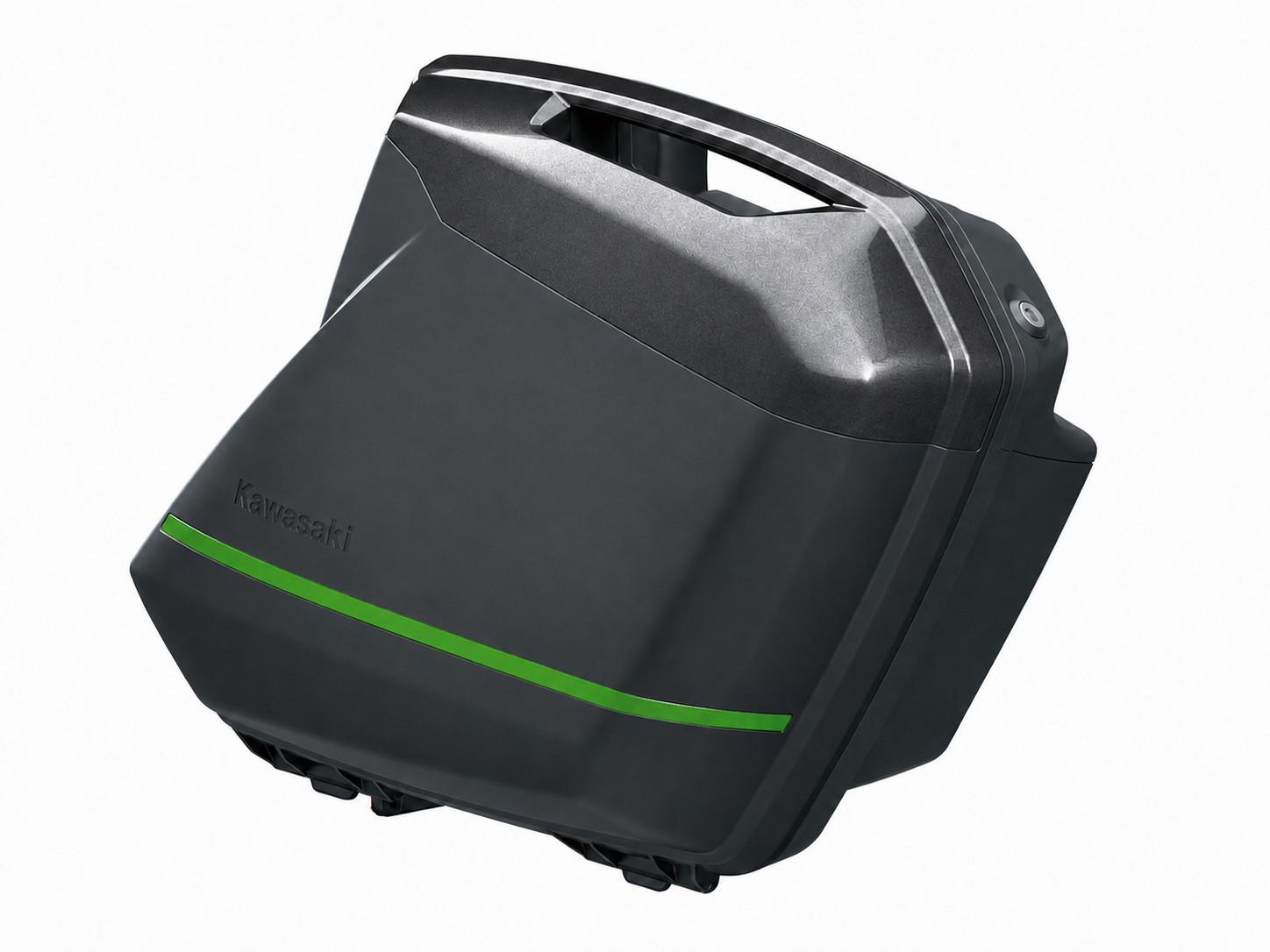
KQR Pannier System 51A/17K
Quick-release 56-litre pannier system for Ninja H2 SX & Ninja H2 SX SE
Designed to hold most full-face helmets, the panniers attach neatly to the factory handgrips and leave a clean, uncluttered look when removed. The One-Key System allows you to operate the pannier locks with your bike’s ignition key, while colour-matched covers and deco stripes ensure a seamless match with your motorcycle's colour scheme.
The Pannier system exists out of 5 parts:
- Pannier Set (2 X 28L)
- Colour Specific Pannier Cover Set
- Colour Specific Deco Stripe Set
- Pannier Fitting Kit
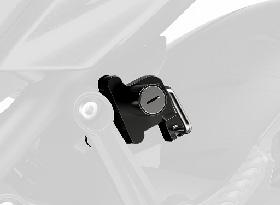
- Lock Cylinder Set
For this model, the KQR pannier system cannot be combined with the top case system.
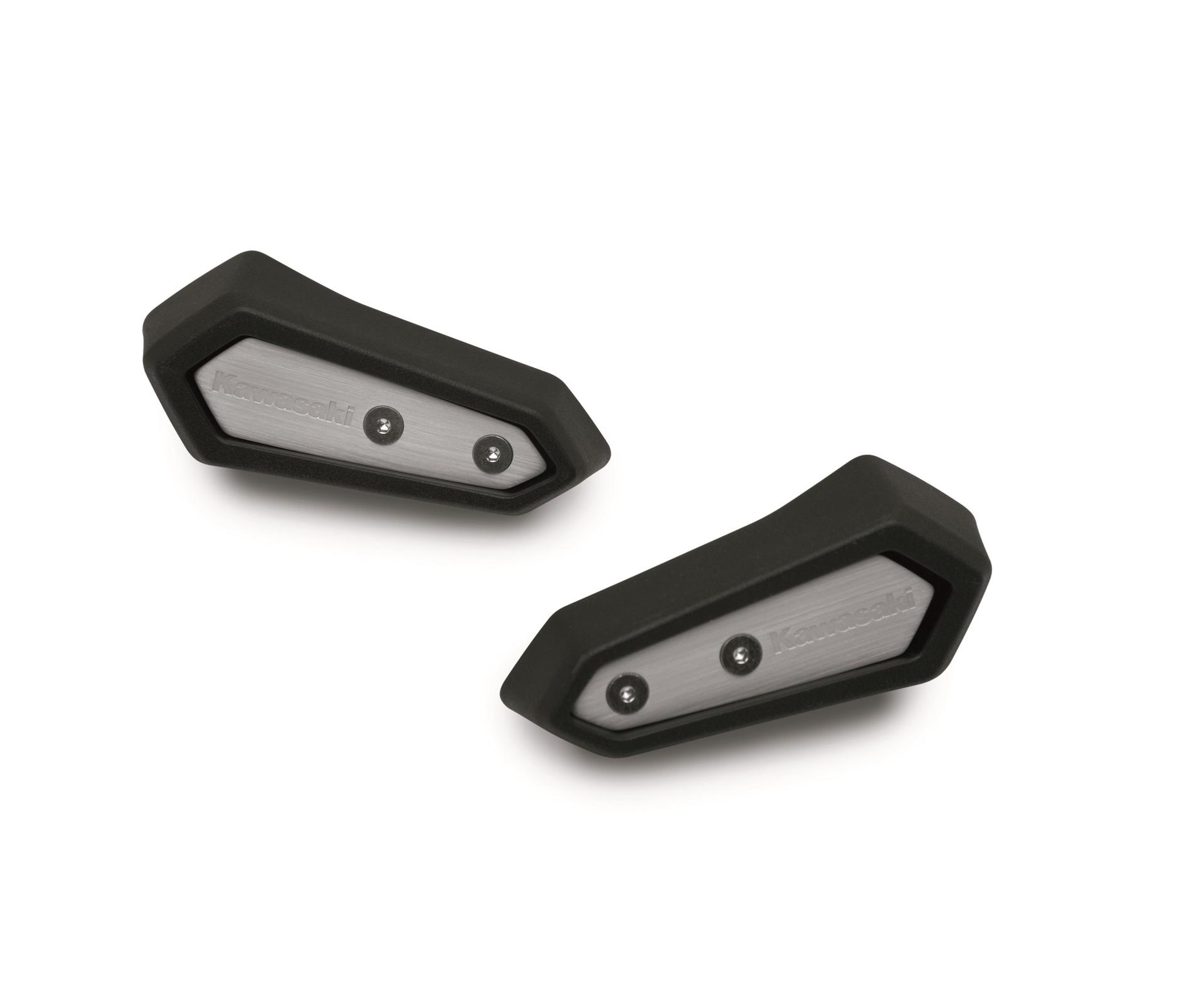
Frame Sliders
Help protect your motorcycle from tip-over damage.
- High-density black ABS plastic Frame Sliders feature the Kawasaki logo and are mounted with factory-designed metal brackets
- Includes required brackets, hardware and installation instructions
- Frame Sliders help protect your motorcycle but will not prevent all types of damage
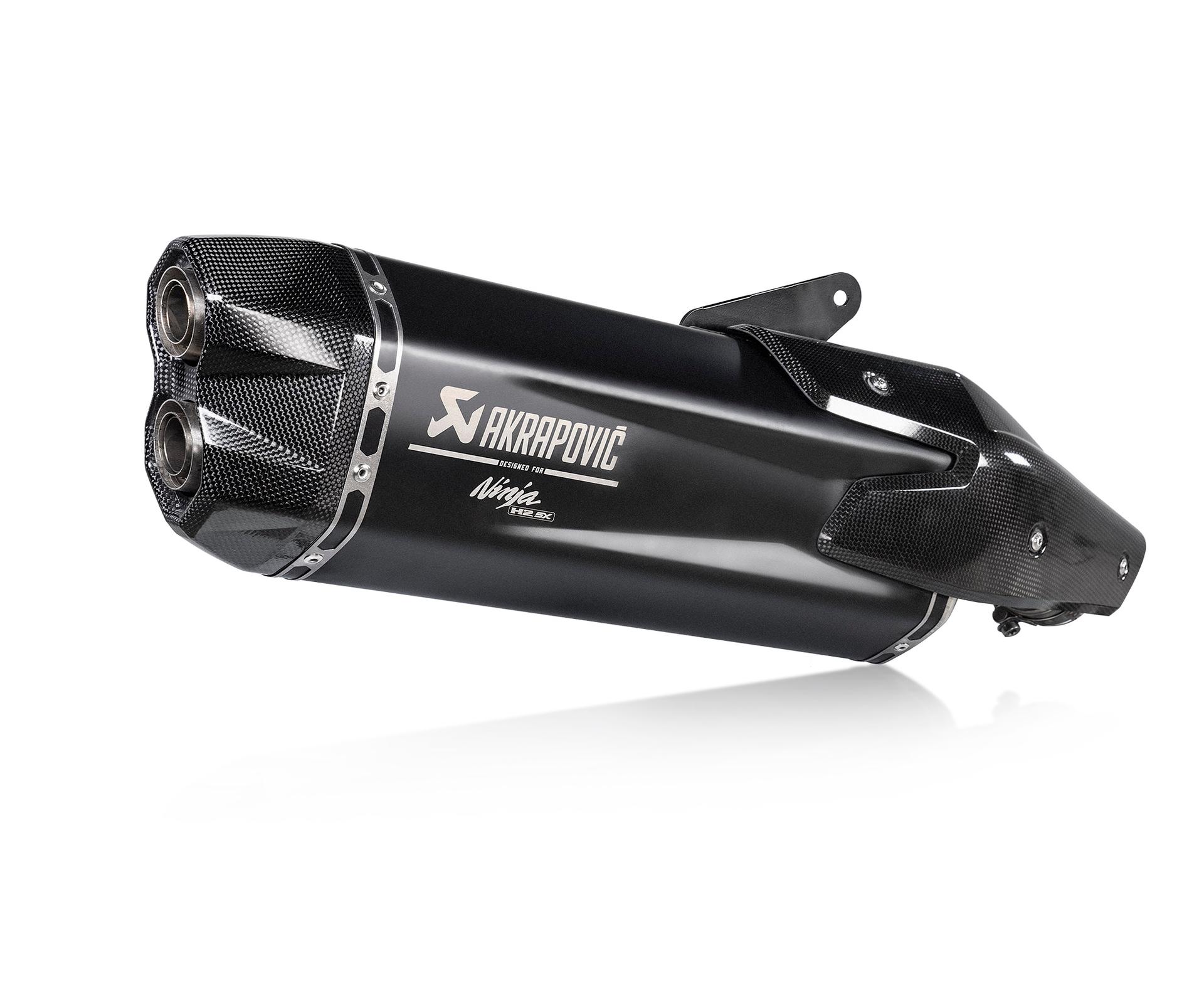
Akrapovič Titanium Exhaust (Euro 5+)
Give your Kawasaki bike a more sporty look and sound with this Akrapovič slip-on exhaust. The lightweight titanium slip-on muffler features a laser marked logo, carbon end cap and carbon heat shield. This exhaust with catalyst is homologated and has ECE type-approval (Euro 5+).
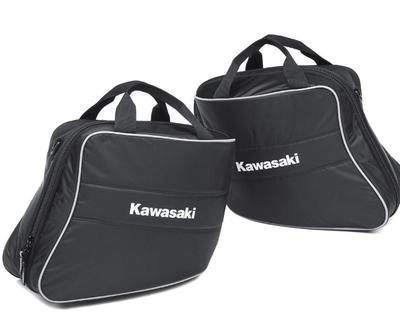
Pannier Inner Bag Set (2 x 28L)
Zippered black nylon liners make it easy to pack your cargo and drop into the locking panniers.
Once you’ve arrived at your destination, just grab your pannier inner bags so you can leave the panniers on your motorcycle and get going.
- Left and right liner
- Purchase as an optional component of the 28L Panniers, sold separately
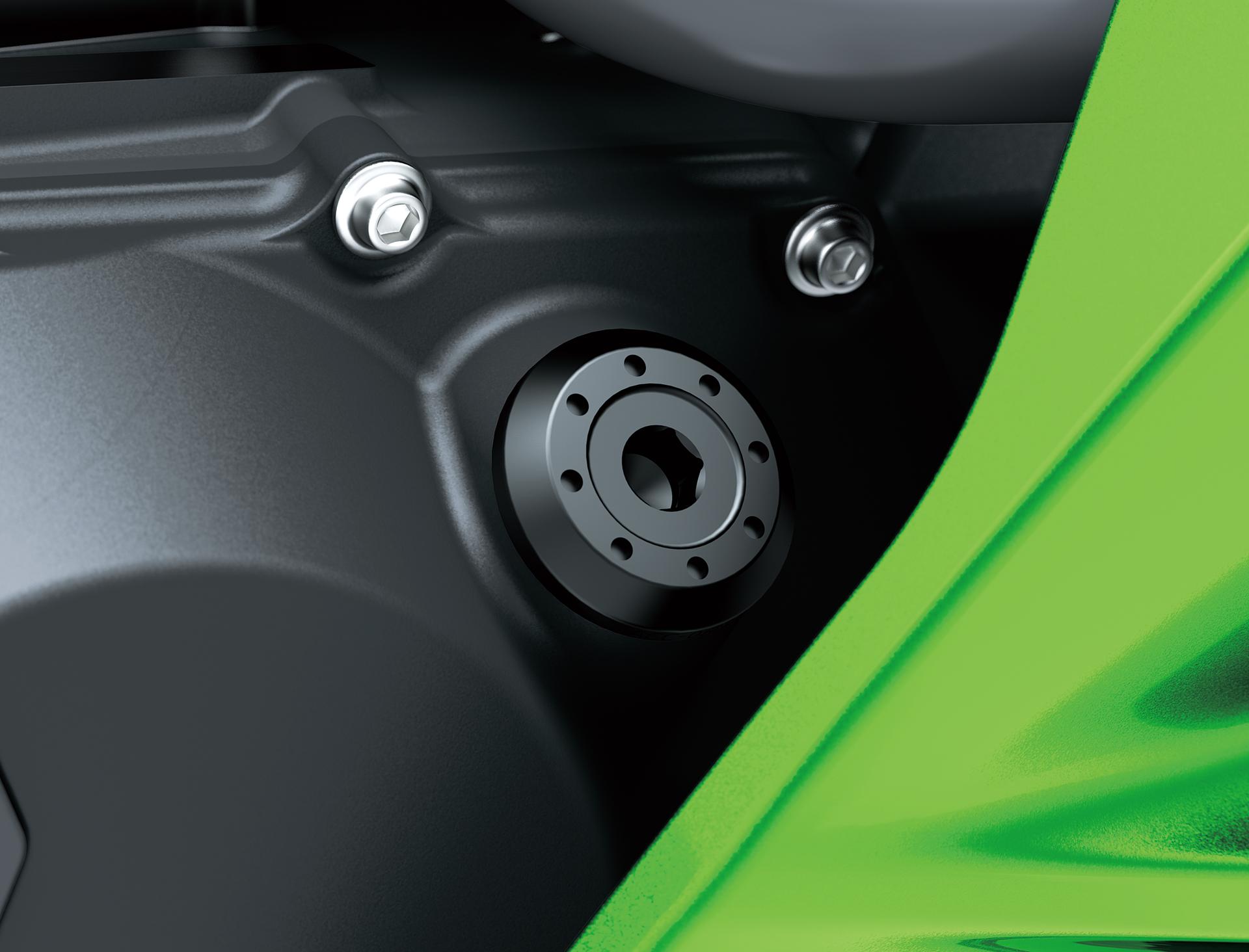
Oil Filler Cap
Stylish machined aluminium oil filler cap with inner hexagon.
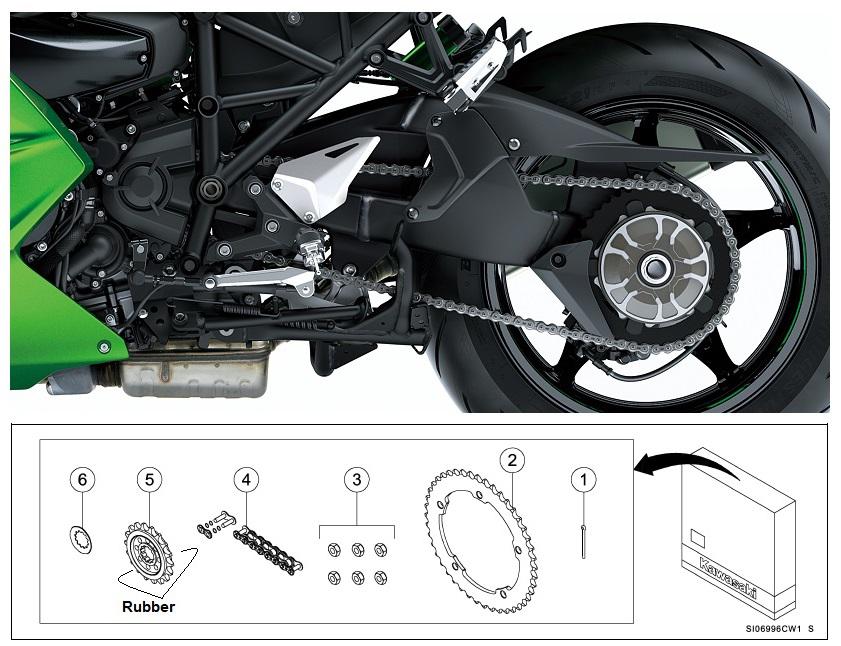
Genuine Chain and Sprocket Kit Ninja H2 SX/SE (ZXT02A/B/D/P/R)
Genuine Kawasaki chain kit containing engine Sprocket, washer, rear sprocket, nuts and cotter pin etc.
This complete package from Kawasaki contains all the qualified genuine parts required for correct drive chain replacement for popular models.
Compared to aftermarket kits, the genuine kits have the advantage of a rubber coated front sprocket, that will make the chain operation much more quiet. Somebody who has been running an aftermarket kit will know this difference.
The new chain kits have the recognizable green Kawasaki branded packaging.
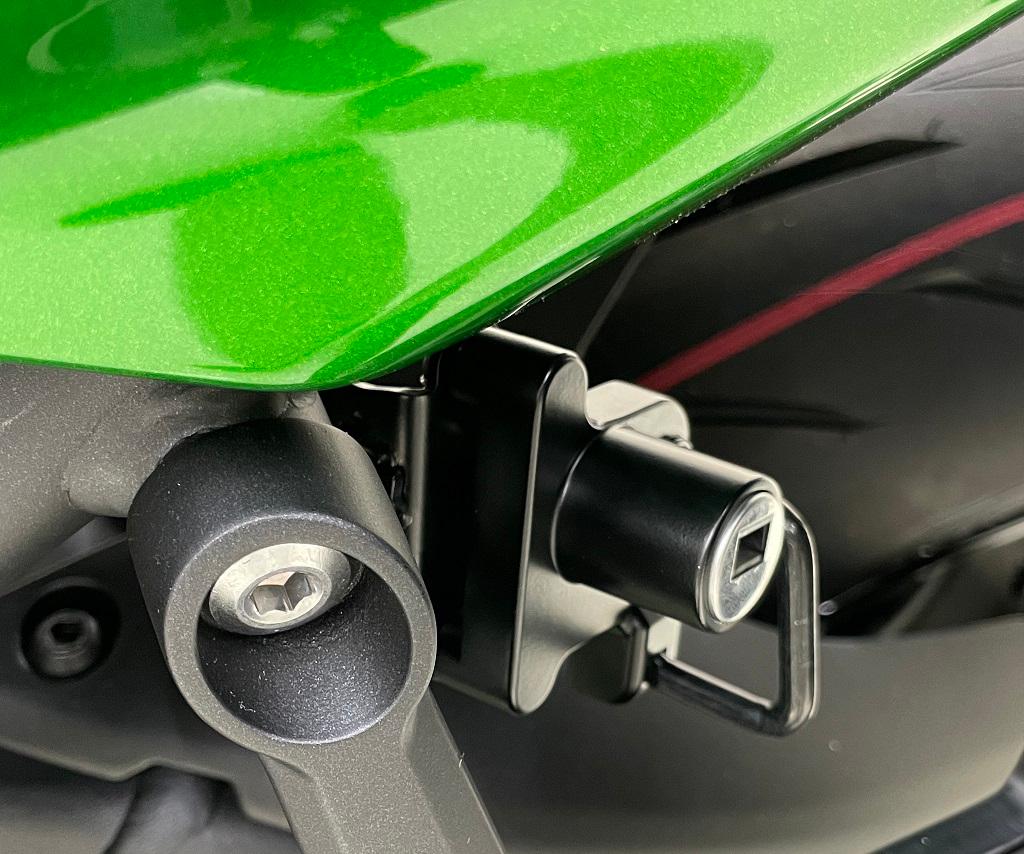
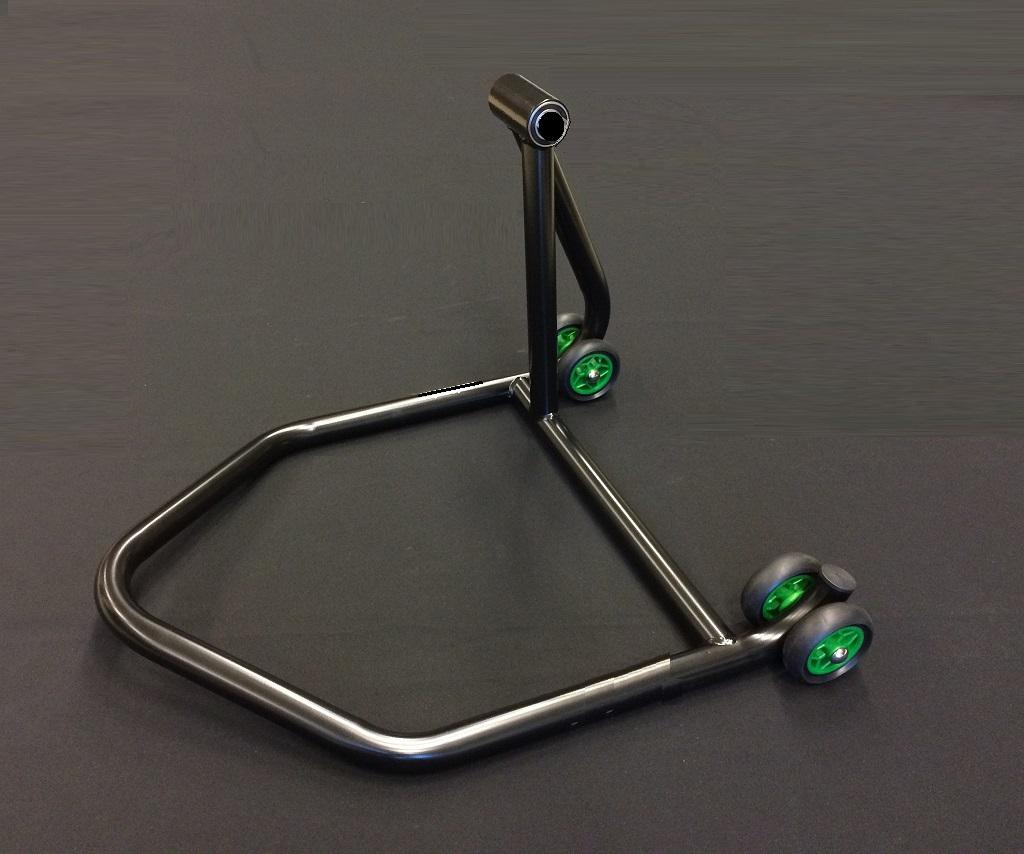
Premium Single Sided Rear Paddock Stand
Special single-sided rear swingarm stand made specially for the Ninja H2 models.
- Extra wide for easier fitment and higher to enable room for tire warmers
- Strong 35mm diameter steel tubing with black powder coating
- Pin can rotate freely in 2 ball bearings
- Wheels are coloured nylon with a soft rubber tyre
- L70 x W63 x H43 cm, weight 5,8kg.
Required bike axle pin sold separately.
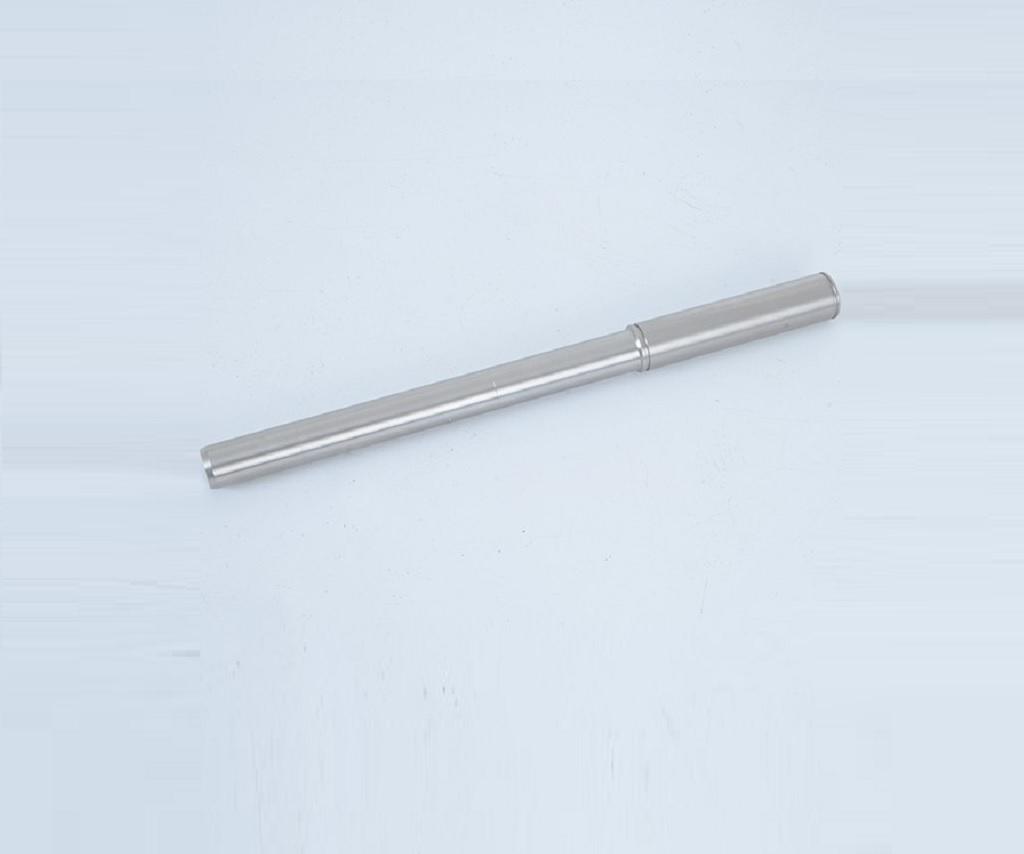
Single Sided Rear Paddock Stand Pin, 20.5mm (Ninja H2 SX/SE)
Special single-sided rear swingarm stand made specially for the Ninja H2 models.
- Extra wide for easier fitment and higher to enable room for tire warmers
- Strong 35mm diameter steel tubing with black powder coating
- Pin can rotate freely in 2 ball bearings
- Wheels are coloured nylon with a soft rubber tyre
- L70 x W63 x H43 cm, weight 5,8kg.
Required bike axle pin sold separately.
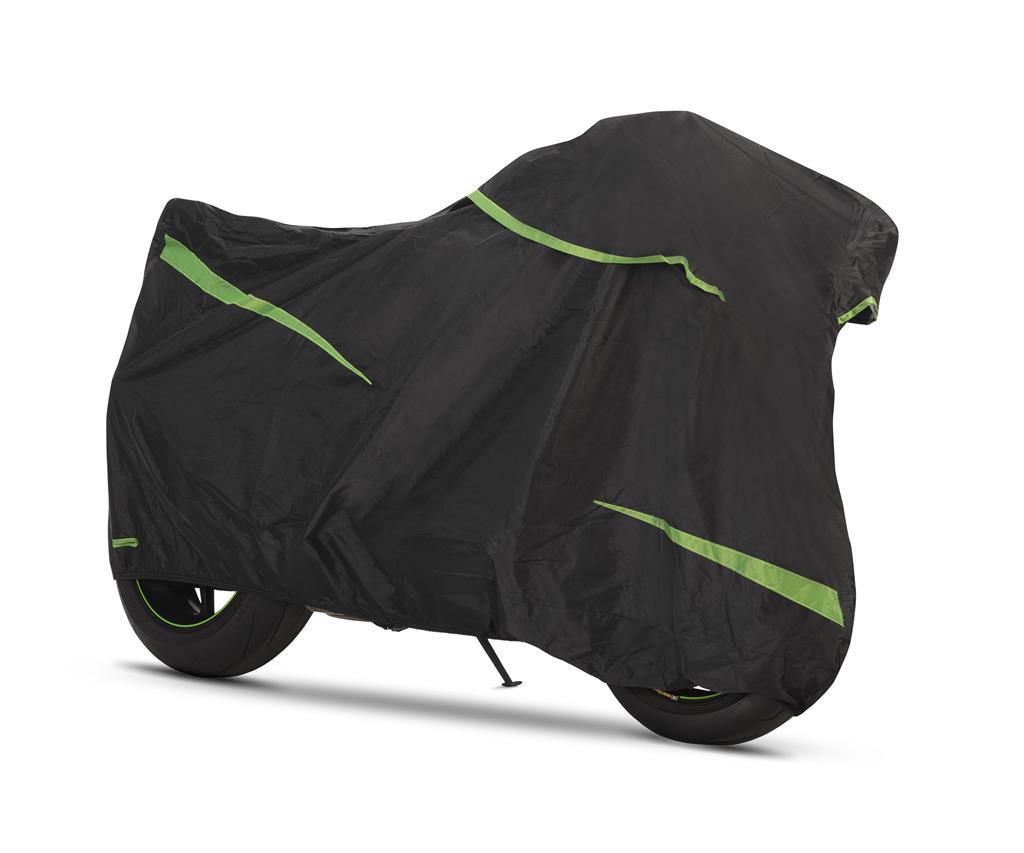
Heavy Duty Outdoor Cover - Extra Large + Top Case
Made from strong Anti-tear Honeycomb ripstop fabric. Heat resistance till 120 degrees Celsius. Subtle branding.
100% Polyester. With multi usable (back)packing string bag.
(XL + top case cover has extra compartment that can be zipped open to make room for top case)
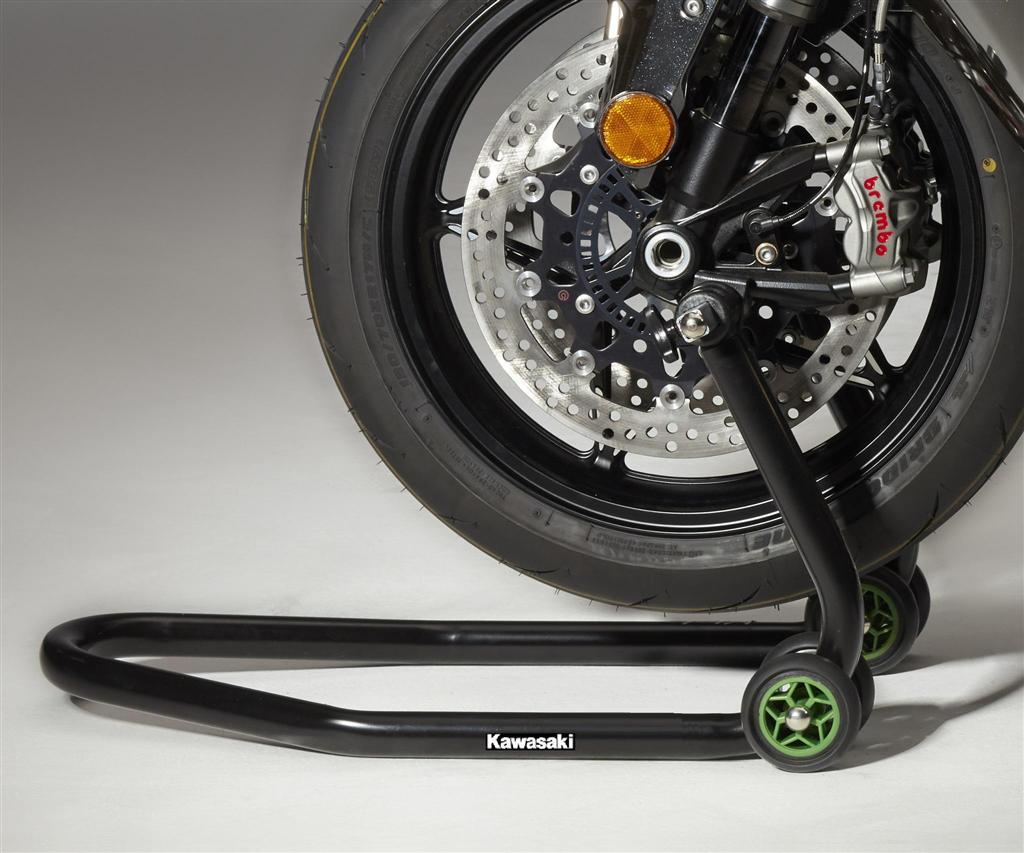
Ninja Outdoor Cover
Made from strong Anti-tear Honeycomb ripstop fabric. Heat resistance till 120 degrees Celcius. Subtle branding.
100% Polyester. With multi usable (back)packing string bag.
Fits:
- Ninja 125
- Ninja 400
- Ninja 650
- Ninja 1000SX (without panniers)
- Ninja H2 SX/SE (without panniers)
- Ninja ZX-4R/RR
- Ninja ZX-6R
- Ninja ZX-10R/RR
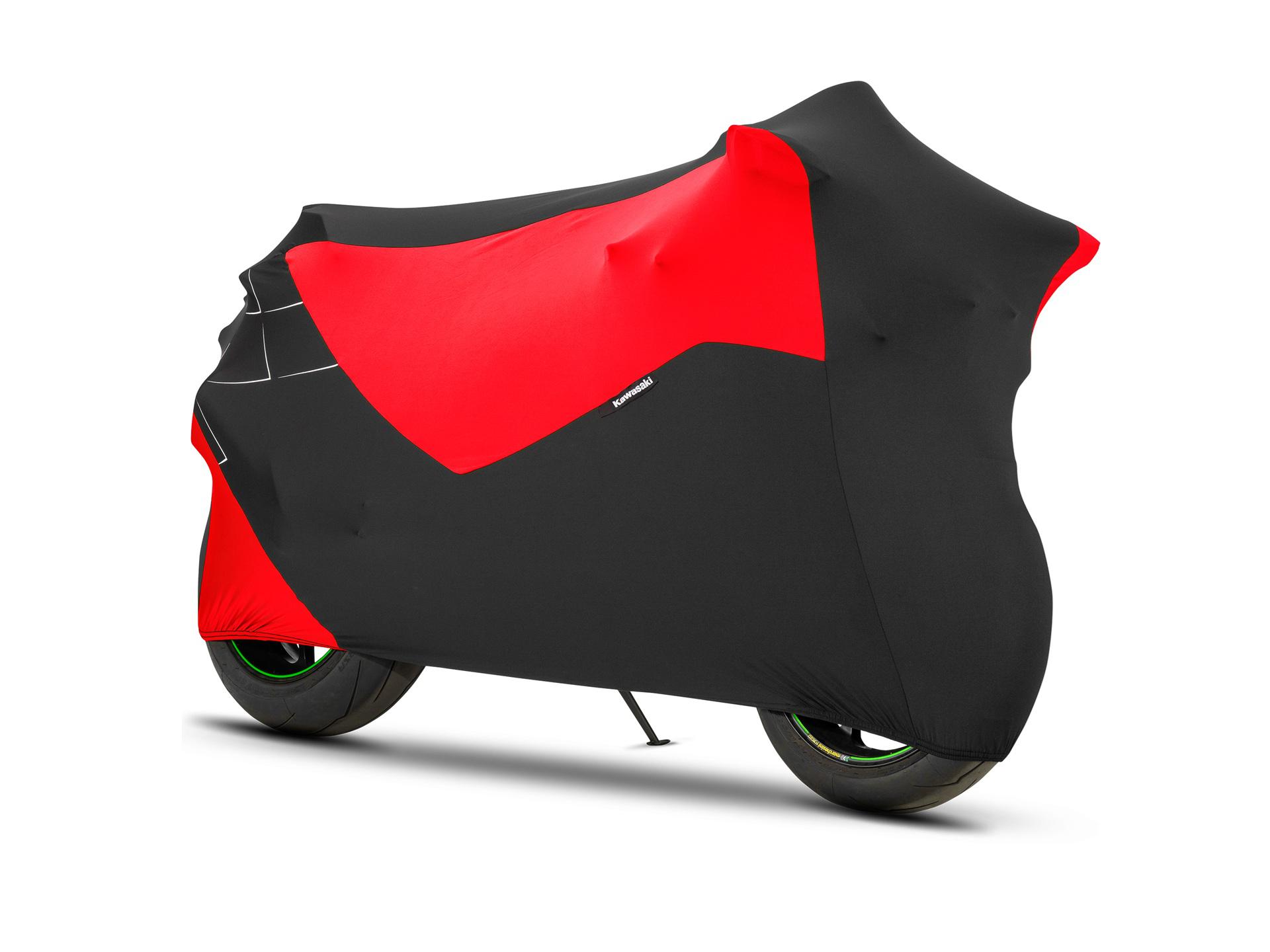
Phone Mount Kit SP Connect SPC+ (Magnet)
Developed in conjuction wih SP Connect the kit consists of a Clutch Mount, Anti-vibration module and a SPC+ Marnetic connector and also a universal Phone Clamp. Suits mosts mobile phones; Simply pull out the crown, screw it tight, and then push the crown back in to lock your phone in place. While remaining fully operable, your phone can now be attached to or detached from the mount in seconds.
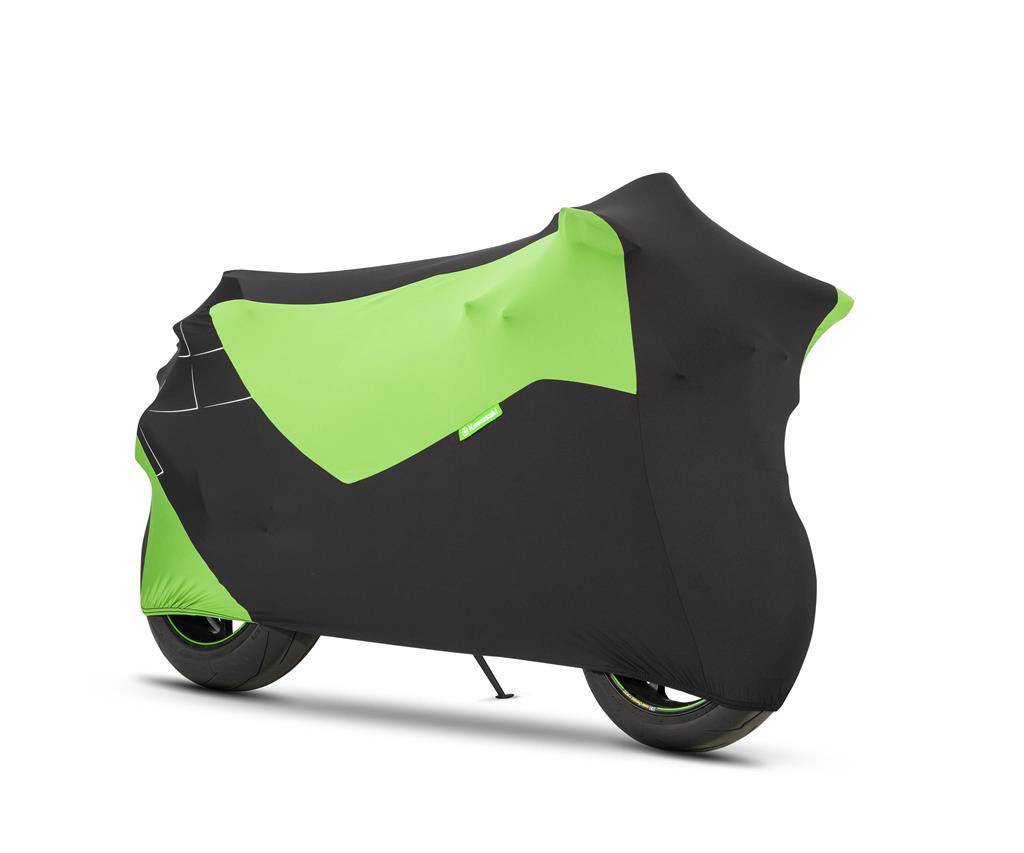
Mechanics Carpet (Pit Mat), 100cm x 200cm
Whether you want to park your bike in a pitbox or in your garage, let your precious machine rest in style on this Kawasaki Garage Mat. The mat meets new FIM environmental codes and offers a high level of absorption and dust-control features.
- Size 100cm x 200cm
- Pile weight ± 300 gr/m²,
- Total height ± 5 mm,
- 30°C washable (no tumble-dry)
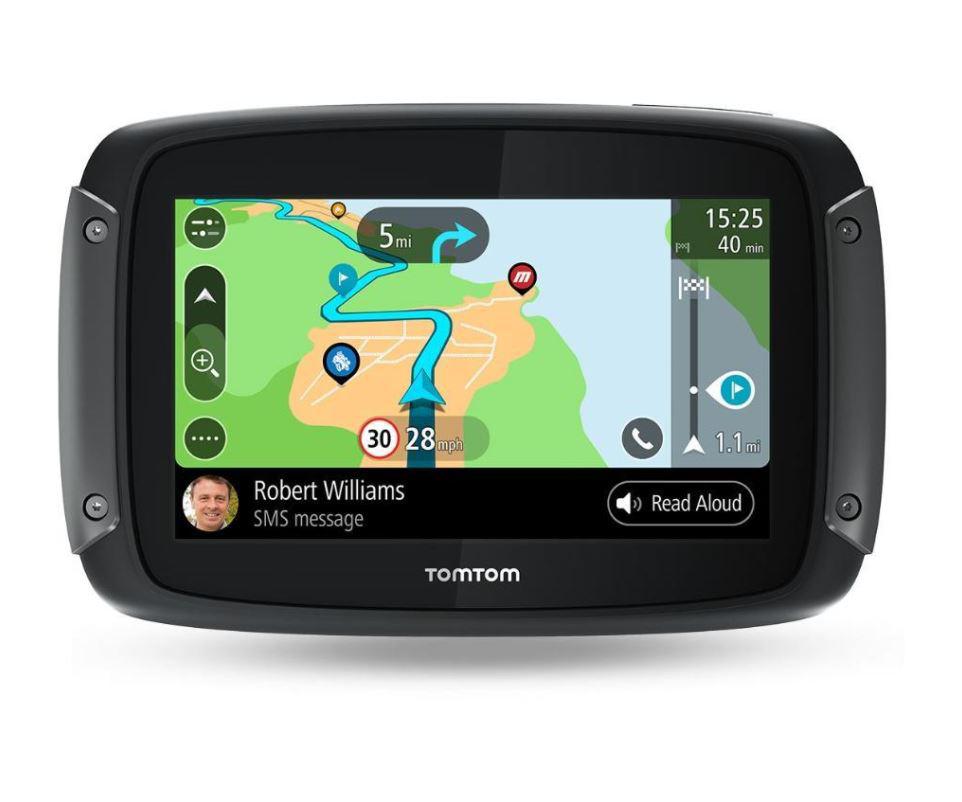
TomTom Rider 550
Discover your next adventure
Ride challenge level. Plan windy and hilly roads
Discover the world's best curated riding routes, exclusively
Updates via Wi-Fi®. No computer needed
Discover, personalize and enjoy stunning riding routes with MyDrive
Compatible with Siri and Google Now™
Smartphone messages read aloud, hands-free calling
Lifetime* Worldwide Maps, TomTom Traffic and Services
Double the processing speed and five times faster start-up
- KQR Pannier System 51A/17K
- Frame Sliders
- Akrapovič Titanium Exhaust (Euro 5+)
- Smoke Windscreen
- One-Key System Helmet Lock
- Pannier Inner Bag Set (2 x 28L)
- Oil Filler Cap
- Genuine Chain and Sprocket Kit Ninja H2 SX/SE (ZXT02A/B/D/P/R)
- One-Key System Helmet Lock
- Premium Single Sided Rear Paddock Stand
- Single Sided Rear Paddock Stand Pin, 20.5mm (Ninja H2 SX/SE)
- Heavy Duty Outdoor Cover - Extra Large + Top Case
- Premium Front Paddock Stand
- Ninja Outdoor Cover
- Heavy Duty Outdoor Cover - Medium
- Super Stretch Cover, Red / Black
- Phone Mount Kit SP Connect SPC+ (Magnet)
- Super Stretch Cover, Green / Black
- GPS Bracket Adapter Kit for TomTom 400/500 Series (4xx/5xx)
- Mechanics Carpet (Pit Mat), 100cm x 200cm
- TomTom Rider 550